Article
Third Quarter Picks Up Pace for $100M+ Chapter 11 Filings
Legal Analysis: Jessica Steinhagen
Data Analysis: Ian Howland, Johanna Schaaper, Gazi Shihab
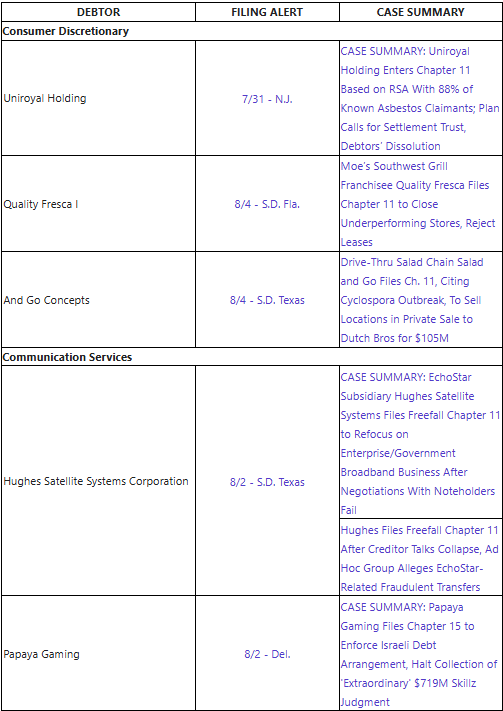
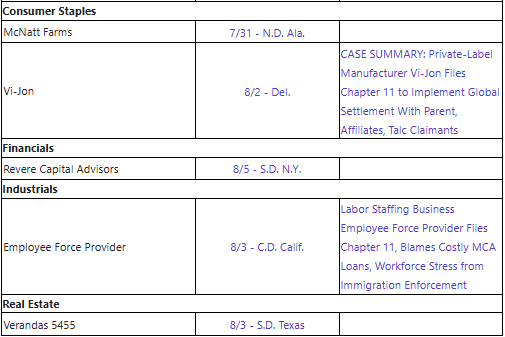
The week’s largest case was a freefall from EchoStar subsidiary Hughes Satellite Systems. The next largest came in the form of two prearranged cases, each taking a different approach to address mass tort claims. Private label manufacturer Vi-Jon LLC entered into an RSA with parties including an ad hoc group of talc claimants contemplating a channeling injunction, while Uniroyal Holding Inc.’s RSA with an ad hoc group of law firms representing asbestos claimants provides for a settlement trust and dissolution of the debtors without a channeling injunction.
A pair of restaurant chains also filed chapter 11 – And Go Concepts LLC, doing business as drive-thru salad chain Salad and Go, and Quality Fresca I LLC, a Moe’s Southwest Grill restaurant franchisee. Quality Fresca attributes its filing to decreased demand, cost increases and labor issues, while Salad and Go blames a rapid expansion, along with price increases and the recent cyclospora outbreak reducing demand.
In a continuing trend, particularly on the lower end, Employee Force Provider Inc., a labor staffing business, filed to address merchant cash advance, or MCA, loans. Employee Force Provider says the effective APR paid to one MCA lender is more than 200%.
Revere Capital Advisors LLC, a New York-based boutique financial services firm, also filed, along with Elkmont, Ala.-based McNatt Farms.
Also this week, Papaya Gaming Ltd., a Tel Aviv-based multiplayer mobile gaming platform developer, filed a chapter 15 seeking recognition of an Israeli insolvency proceeding.
Chapter 11s with liabilities as low as $10 million continue to outpace all prior years in the First Day Database. The graph below shows the timeline of the aggregate annual chapter 11 filing count for this year and the previous seven.

Looking at the $100 million to $1 billion range for liabilities, 2026 is trending around the 2019 – 2025 average, while sitting well below 2020 and 2023.

While the year-to-date filing frequency for this range remains down, things are beginning to accelerate, as shown by the steepening of the 2026 line in the graph above after it crosses into July, bringing it quickly in line with 2024 and 2025. This Q3 increase is displayed more vividly in the graph below, which shows the 30-day average filing frequency for each quarter. Last quarter, there were close to seven cases per 30-day period on average. So far in Q3, the average sits just under 11.

For filings in this range, the consumer discretionary dominates, eclipsing the Jan. 1 – Aug. 7 totals for each of 2024 and 2025. Also elevated is the number of cases in this liability segment that were filed by companies outside of recent historical top five sectors.
Looking closer at 2026, we can see the relatively balanced composition across the sectors behind consumer discretionary, which towers over the rest.

For billion-dollar filings, 2026 continues to see a slower pace relative to the prior three years.

And Go Concepts LLC, doing business as salad drive-thru chain Salad and Go, filed on Aug. 4 in the Southern District of Texas. The debtors seek to wind-down and have “engaged in discussions with numerous parties regarding a sale of the Debtors’ assets.” The debtors seek approval of a private sale to Boersma Bros. LLC, which does business as Dutch Bros, for $105 million in cash plus assumption of liabilities, subject to adjustment. The debtors expect that the sale proceeds would be sufficient to pay all allowed claims in full, according to the sale motion.
Salad and Go reached a high of 146 locations in Arizona, Nevada, Texas and Oklahoma. The debtors closed 75 locations, primarily in Texas and Oklahoma, ahead of the filing. The company attributes the filing, in part, to the recent cyclospora outbreak, along with a troubled expansion.
Quality Fresca I LLC, a Palm Beach, Fla.-based operator of 38 Moe’s Southwest Grill restaurants, filed on Aug. 4 in the Southern District of Florida. Between 2020 and 2021, the debtor acquired 69 franchised Moe’s Southwest Grill locations in Florida, South Carolina, Virginia, Maryland and the District of Columbia.
The franchisee attributes the bankruptcy filing to decreased foot traffic, competitive pressures, recent increases in costs of shipping and food, decreased availability of labor, and inflation. The company closed underperforming stores ahead of the filing. In August 2025, the franchisor notified the debtor it was in default under all of the franchise agreements. Negotiations with the franchisor and the debtor’s lender are ongoing.
Vi-Jon LLC, a St. Louis-based private-label manufacturer, filed on Aug. 2 in Delaware, after entry into an RSA with its parent, Emprise Group Inc., several Emprise subsidiaries/nondebtor affiliates, an ad hoc group of talc claimants representing 80% of holders of talc-related claims against the debtor and its affiliates, and retired bankruptcy judge Shelley C. Chapman as the future talc claims representative. The RSA represents a global resolution of talc claims against the debtor and the nondebtor affiliates and would be effectuated through a chapter 11 plan, the establishment of a trust for the benefit of talc claimants and the issuance of a channeling injunction under section 524(g) of the Bankruptcy Code.
Vi-Jon is named in 367 active litigation cases, 356 of which involve mesothelioma and 11 of which involve lung cancer, all allegedly caused by exposure to the debtor’s historical talc products. The debtor faces “myriad” financial challenges, including shifting market dynamics and customer losses. However, the “greatest catalyst” for the debtor’s strained liquidity position and the need to commence the chapter 11 case was an “unexpected and unforeseen” substantial increase in talc-related claims that began in 2024.
At Wednesday’s first day hearing, Judge Mary F. Walrath approved Vi-Jon’s first day relief without objection. Debtor’s counsel said that the filing was triggered by a surge in talc-related litigation against the company, increasing to $720 million (with a net present value of $159 million), overwhelming the debtor’s operational cash flow. Debtor’s counsel said that the company intends to fund operations and the costs of the case through a combination of cash on hand, cash receipts, approximately $8.1 million of remaining undrawn capital commitments from parent Emprise under a capital contribution agreement and $7 million in exit financing funded by affiliates.
Naugatuck, Conn.-based Uniroyal Holding Inc. and affiliate Great Hill Corp. filed for chapter 11 protection on July 31 in New Jersey. The case is based on a restructuring support agreement with an ad hoc group of law firms representing nearly 90% of known asbestos personal injury or wrongful death claimants. The RSA, as incorporated in a plan, provides for satisfaction in full of all non-personal injury/wrongful death claims, a settlement trust to resolve present and future personal injury/wrongful death claims, and the dissolution of the debtors.
The debtors would also seek approval of a consensual modification of the company’s retiree benefits program to provide fully paid life insurance benefits and funds to purchase comparable or better individual medical and drug benefits coverage in exchange for termination of Uniroyal’s obligations under the program.
Debtor Uniroyal Holding Inc. is a wholly owned subsidiary of Uniroyal Inc. Uniroyal Holding does not have an operating business but has provided post-employment welfare benefits to retirees and managed litigation, of which the most costly are asbestos-related claims. According to the first day declaration of Uniroyal President and board member Robert D’Angelo Jr., the liabilities associated with asbestos textiles were expressly assumed as part of the 1985 restructuring.
The company had a total of 2,800 pending asbestos-related claims in 1986, but this has increased to a total of 516,656 claims since Uniroyal Holdings’ formation. The company has paid $160 million in defense costs and paid about $500 million to resolve 216,994 cases, leaving more than 35,000 pending cases. Uniroyal Holding says it “may be the last, or one of the last, asbestos product manufacturers to file for bankruptcy.”
Judge Michael B. Kaplan granted the Uniroyal Holding debtors’ first day relief at Monday’s first day hearing and set a hearing on the disclosure statement for their prearranged plan for Sept. 10 at 11:30 a.m. ET.
EchoStar subsidiary Hughes Satellite Systems, which comprises the majority of EchoStar’s broadband and satellite segment, and 11 affiliates, filed a freefall chapter 11 in the Southern District of Texas on Aug. 2. The filing came after unsuccessful restructuring and forbearance negotiations with an ad hoc group of holders of senior notes, which matured on Aug. 1. The debtors’ long-term restructuring goal is to refocus on their enterprise and government broadband services segment as their consumer broadband business winds down.
The disputed transactions cited by the senior noteholder ad hoc group include an allegedly above-market satellite lease with EchoStar XXIV, approximately $1 billion in dividends paid to EchoStar in February and March 2024, approximately $196 million in income tax reimbursements paid to EchoStar in 2024 and “the referral of the Company’s consumer subscribers to SpaceX in connection with EchoStar’s sale of certain spectrum assets to SpaceX.”
Hughes is the third EchoStar segment to file chapter 11 this summer, with the company’s DISH DBS pay-TV and legacy DISH Wireless business filing a combined prepackaged chapter 11 case on June 30.
At a hearing on Tuesday, Judge Alfredo R. Perez granted the Hughes debtors’ interim cash collateral use, overruling an objection from the senior noteholder ad hoc creditor group.
Sale-related events for the week’s cases are recapped below:
And Go Concepts (Salad and Go)
Salad and Go is a drive-thru salad chain with 70 locations in Arizona and Nevada. Their lease portfolio has approximately 130 locations in Arizona, Texas, Nevada, Oklahoma and unopened sites in California.
Seeks approval of a private sale to Boersma Bros., which does business as Dutch Bros, for $105 million in cash plus assumption of liabilities, subject to adjustment. The purchased assets are the debtors’ leasehold portfolio for 51 Salad and Go drive-through locations in Arizona and Nevada plus 14 additional leases in Texas and Oklahoma.
Dutch Bros, a drive-through beverages and coffee shop, is publicly traded on the New York Stock Exchange under the “BROS” ticker.
Single asset real estate cases from the week, in lieu of an individual filing alert, are listed below:
This publication has been prepared by Octus Intelligence, Inc. or one of its affiliates (collectively, "Octus") and is being provided to the recipient in connection with a subscription to one or more Octus products. Recipient’s use of the Octus platform is subject to Octus Terms of Use or the user agreement pursuant to which the recipient has access to the platform (the “Applicable Terms”). The recipient of this publication may not redistribute or republish any portion of the information contained herein other than with Octus express written consent or in accordance with the Applicable Terms. The information in this publication is for general informational purposes only and should not be construed as legal, investment, accounting or other professional advice on any subject matter or as a substitute for such advice. The recipient of this publication must comply with all applicable laws, including laws regarding the purchase and sale of securities. Octus obtains information from a wide variety of sources, which it believes to be reliable, but Octus does not make any representation, warranty, or certification as to the materiality or public availability of the information in this publication or that such information is accurate, complete, comprehensive or fit for a particular purpose. Recipients must make their own decisions about investment strategies or securities mentioned in this publication. Octus and its officers, directors, partners and employees expressly disclaim all liability relating to or arising from actions taken or not taken based on any or all of the information contained in this publication. © 2026 Octus. All rights reserved. Octus(TM) and the Octus logo are trademarks of Octus Intelligence, Inc.