Octus: The Essential Credit Platform
Infrastructure built for the credit market
The speed of sub-investment-grade credit leaves no room for fragmented intelligence.
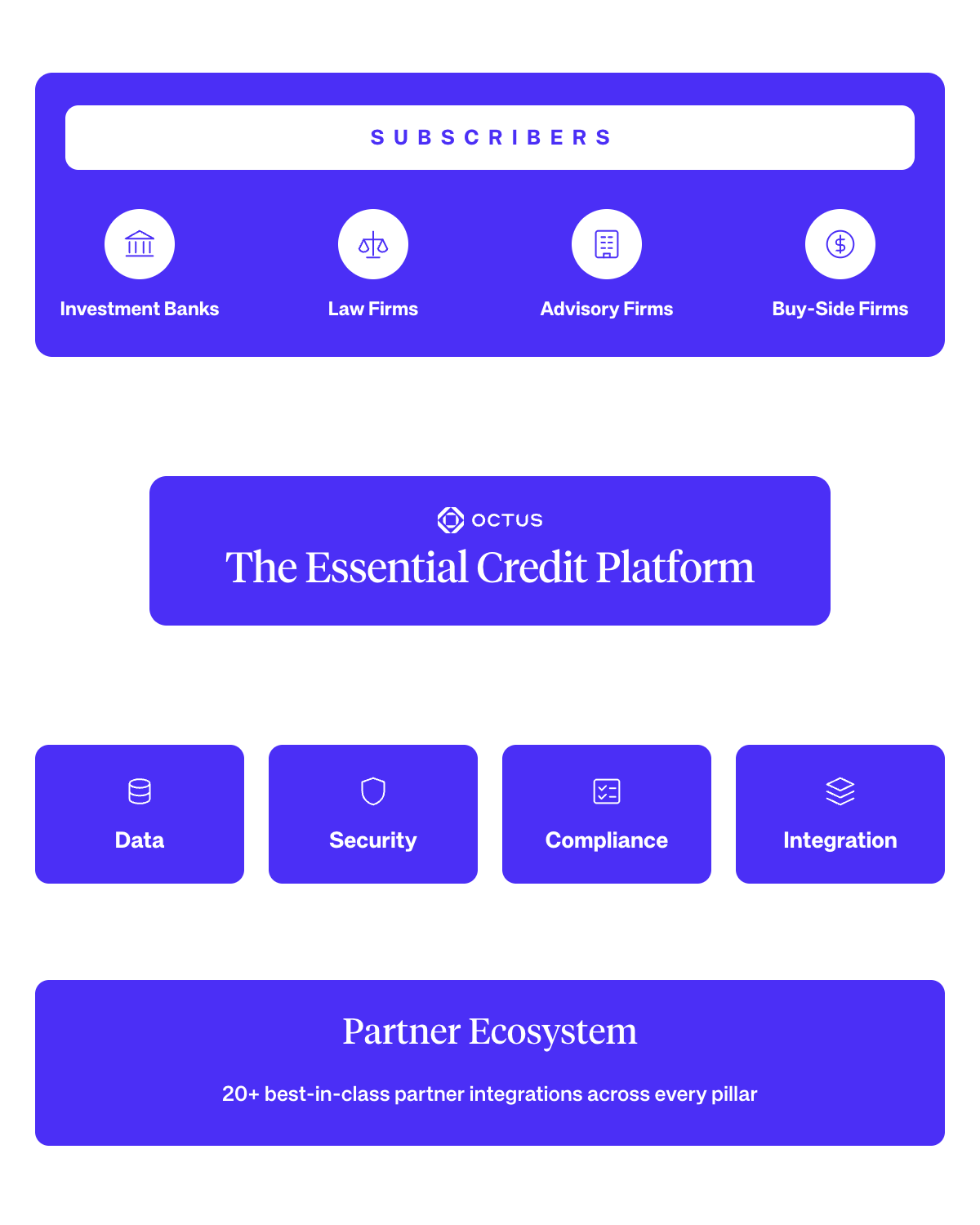
Octus sits at the center of the market with an enterprise-grade platform purpose-built to the highest global standards for security, compliance, uptime and encryption.
This is unmatched corporate credit confidence.
PILLAR 01
Data
The intelligence you act on is sourced, validated and classified with precision. Every field has a lineage. Every correction has an audit trail. Octus data arrives structured, verified and ready to act on.
OWNERSHIP
- Named data owner and steward per domain: deal data, fund data, news, reference
- Data dictionary with field-level definitions, business rules and ownership
- Data governance council with cross-functional representation
- Escalation path for data disputes, quality issues and policy ambiguities
LIFECYCLE MANAGEMENT
- Retention schedules by data type and sensitivity tier
- Deletion and anonymization procedures with verification
- End-to-end lineage from source ingestion through every transformation to delivery
- Provenance tracking for all derived or model-generated fields
DATA CLASSIFICATION
- Auto-classification at ingest based on source type and content signals
- Human review triggers for ambiguous or novel content types
- Re-classification process when data status changes (e.g., deal closes publicly)
- Tier-specific rules for storage, access, transmission and disposal
SENSITIVITY TIERS
- Tier 1: Public / unrestricted, open redistribution permitted
- Tier 2: Licensed / controlled, redistribution restricted by client agreement
- Tier 3: Proprietary, internal use and direct client delivery only
- Tier 4: Embargoed, time-locked until defined publication window
- Tier 5: MNPI-adjacent, requires ethical wall controls and access logging
VALIDATION
- Field-level validation: range checks, format validation, referential integrity
- Cross-source reconciliation for high-impact data points (deal sizes, fund metrics)
- Outlier detection with automated quarantine queue and human review
- QA scoring by data type with defined maximum acceptable error rates
COMPLETENESS
- Universe coverage monitoring: defined which deals, funds and companies are in scope
- Freshness SLAs by type: news real-time, reference T+1, fund data as-reported
- Tiered correction SLAs: P1 market-moving errors resolved in under 30 minutes; P2 in under 4 hours
- Client-facing correction notice workflow with immutable audit trail
SOURCE MANAGEMENT
- Primary source taxonomy covering court systems, regulatory filings, wire services and GP portals
- Source scoring by reliability, latency and historical accuracy
- Cross-validation protocols for high-impact data points across independent sources
- Confidence tier assigned at ingest based on source quality and corroboration level
INGESTION
- Automated ingestion with schema validation at point of entry
- Feed monitoring with latency alerting and gap detection
- Source-level audit trail preserved from raw ingest to published output
- Vendor and data partner contracts aligned to SLA and redistribution requirements
EDITORIAL ACCURACY
- Published accuracy standards and editorial code of conduct
- Editorial independence policy with defined firewall from commercial teams
- Multi-stage review and approval process scaled by content sensitivity
- Corrections process with mandatory post-publication notices for material errors
WORKFLOW
- Centralized editorial workflow system with assignment tracking and version history
- Role-based access controlling who can publish vs. draft vs. review
- Style guide and terminology standards applied consistently across all output
- Training program for new editorial staff on standards and legal requirements
EMBARGO CONTROLS
- System-enforced embargo holds with time-locked release windows
- Blackout rules aligned to regulatory calendars and deal timelines
- Embargo breach detection with immediate escalation and audit logging
- Client-specific publication windows where contractually required
PUBLICATION TIMELINES
- Structured deal milestone tracking from launch through close
- Automated timeline updates triggered by sourced event data
- Publication scheduling integrated with market event calendar
- Retroactive timeline correction workflow with audit trail
PILLAR 02
Security
Security is the foundation. Rigorous access controls, enterprise-grade threat monitoring and verified-at-every-step authentication are built into every layer of the platform your firm depends on.
PHYSICAL INFRASTRUCTURE
- Cloud architecture (AWS) with defined SLAs
- Geo-redundant data centers with documented failover runbooks
- Disaster recovery with tested RTO and RPO targets by system tier
CONNECTIVITY
- Redundant network paths and provider failover designed to protect feed delivery
- Latency and uptime targets differentiated by product: real-time news vs. reference data
- Direct data-source integrations governed by vendor and partner agreements aligned to SLA and redistribution requirements
SECURITY CONTROLS
- Encryption at rest and in transit, aligned with NIST best practices
- Secrets and key management with defined rotation schedules; access to key management systems restricted and logged
- Data access events logged and routed to centralized security monitoring
- Tenant isolation enforced at the application layer, validated during pre-production testing
MONITORING
- Logically segregated network environments for production, staging and development, with default-deny perimeter rules
- SIEM with real-time alerting and minimum one-year log retention (90 days immediately queryable)
- Strongly authenticated, logged access to administrative interfaces; no direct exposure to the public internet
- Cloud security posture management (CSPM) across all cloud-hosted assets
IDENTITY
- MFA required for all access to cloud management consoles, administrative interfaces, and production systems without exception
- Administrative accounts kept separate from standard user accounts; least-privileged role selected by default
- Service accounts and API credentials tracked with documented owners, minimum required permissions and defined rotation schedules
- Access reviewed at least quarterly; revoked promptly on role change or departure
ENDPOINT SECURITY
- Centrally managed endpoint protection (anti-malware, host firewall) on all corporate devices, continuously monitored
- Continuous, AI-agent-driven penetration testing, with human-in-the-loop validation, replacing point-in-time annual tests with always-on coverage
- Threat modeling performed for significant new features and architecture changes, reviewed by our Architecture Review Board
INCIDENT RESPONSE
- Incident response organized by severity, with a named Incident Commander and Communications Lead activated for high-severity events
- Defined containment, investigation and remediation procedures
- Breach notification to affected parties and regulators within 72 hours of confirmation, or sooner where law or contract requires
- Incident response tested annually through tabletop exercises
VULNERABILITY MANAGEMENT
- Daily vulnerability scanning across infrastructure and application layers
- Findings prioritized by severity and remediated against internal SLAs tracked by the Cybersecurity team
- Third-party and vendor risk assessments for systems handling sensitive data
- Post-incident reviews with documented root cause and corrective actions for high-severity events
ENGINEERING PRACTICES
- Agile delivery with sprint-level data quality gates before environment promotion
- CI/CD with automated testing including data contract and schema validation
- Mandatory code review for all changes touching data pipelines or access control
- Static analysis and dependency vulnerability scanning in build pipeline
PIPELINE GOVERNANCE
- Schema change management: all changes reviewed for downstream product impact
- Environment segregation with no production or client data in dev or staging
- Data contract definitions between pipeline producers and consumers
- Pipeline observability: data volume, latency and error rate dashboards
CHANGE MANAGEMENT
- Release management review process for all production changes
- Release calendar with blackout windows aligned to market events and client reporting
- Rollback procedures defined and tested before every major release
- Client-impact assessment required for API contract or data schema changes
RESILIENCE
- Capacity planning tied to data volume growth and new client projections
- Chaos engineering practices to validate failover and degraded-mode behavior
- SLA monitoring dashboards visible to engineering
- Post-incident reviews with documented corrective actions and named owners
PILLAR 03
Compliance
SOC 2 Type II certified. Information walls that are system-enforced, not policy-dependent. Regulatory frameworks spanning SEC Reg FD, GDPR and MiFID II. Octus meets the compliance standard your risk, legal and procurement teams demand, and we run our controls year-round to prove it.
INTERNAL POLICIES
- Master information security policy with domain-specific sub-policies
- Acceptable use policy covering data handling, devices and communications
- Data handling policy differentiated by classification tier
- Annual policy review cycle with version control and staff attestation
TRAINING
- Mandatory compliance training at onboarding and annually thereafter
- Role-specific training for editorial, research, engineering and sales functions
- Phishing simulation and ongoing security awareness program
- Documented escalation process for raising policy concerns without retaliation
US REGULATORY FRAMEWORK
- SEC Regulation FD: fair disclosure controls on material non-public information
- FINRA guidelines for financial content distribution and recordkeeping
- State privacy laws (CCPA / CPRA) for California-based data subjects
- Dodd-Frank implications for any financial product classification of distributed data
INTERNATIONAL FRAMEWORK
- GDPR / UK GDPR for any EU or UK-sourced personal data
- MiFID II research unbundling rules for EU institutional client distribution
- Cross-border data transfer mechanisms: SCCs and adequacy decisions
- Regulatory change monitoring with assigned compliance owner per jurisdiction
CERTIFICATIONS
- SOC 2 Type II (annual): table stakes for institutional data clients
- ISO 27001 for clients requiring international standard alignment
- Audit scope must include ingestion, processing, storage and delivery systems
- Audit report distribution process with NDA controls for prospective clients
EXTERNAL AUDITS
- Continuous controls monitoring to reduce point-in-time audit burden
- Remediation tracking with SLAs for findings by severity
- Third-party auditor rotation every 3 to 5 years to maintain independence
- Internal audit function or GRC platform for year-round evidence collection
ETHICAL WALLS
- System-enforced information barriers between public and private market teams
- MNPI escalation process with legal review and documented disposition
- Conflict screening at deal intake against existing client and coverage lists
- Wall crossing logs maintained for regulatory examination and internal audit
MNPI CONTROLS
- Real-time alerting for attempted cross-wall access
- Quarterly wall effectiveness review with compliance sign-off
- Staff training on wall obligations specific to role and division
- Regulator-ready documentation package for wall structure and controls
ARCHITECTURE
- Role-based access control (RBAC) and attribute-based access control (ABAC) layered by content sensitivity
- Least-privilege principle enforced with no access beyond documented business need
- Quarterly entitlement reviews with manager certification
- Separation of duties enforced for high-risk functions (publishing, data export, admin)
OPERATIONAL CONTROLS
- Access request workflow with approval chain and time-limited grants
- Emergency access break-glass procedures with mandatory post-use review
- Third-party and contractor access scoped and time-limited by default
- Access anomaly detection integrated with SIEM for behavioral alerting
USER MANAGEMENT
- Automated provisioning workflow tied to HR system and client onboarding process
- SSO enforced for all client-facing and internal platforms
- MFA required for all users; step-up authentication for sensitive data access
- Access certification completed within defined windows; delinquent accounts suspended
IDENTITY LIFECYCLE
- Same-day offboarding process with automated access revocation
- Orphaned account detection and remediation on quarterly cycle
- Client seat audits to reconcile contracted vs. active users
- Account sharing controls and detection to enforce per-user licensing
REDISTRIBUTION CONTROLS
- License agreements with clearly defined permitted uses, redistribution restrictions and data field scope
- Redistribution controls enforced at API and delivery layer, not just contractually
- Watermarking or fingerprinting for high-sensitivity data to enable breach tracing
- Usage monitoring with automated alerts for anomalous extraction volumes
DATA LICENSING
- License compliance review process for client renewals and upsell motions
- Third-party sublicensing approval workflow with legal sign-off
- Client audit rights clause with defined evidence provision obligations
- Usage reporting available to clients to support their own license compliance
PILLAR 04
Integration
Octus fits into your workflow, not the other way around. Access credit intelligence and data through REST API, native Snowflake integration, CreditAI or MCP. All flexible, reliable delivery methods built to the same enterprise standard as every other layer of the platform. Access Octus directly, in the tools you already use, with a full validation trail back to the source.
FEED DELIVERY
- REST API with versioned endpoints and documented deprecation policy
- Bulk data feed delivery with checksum validation and delivery confirmation
- Uptime SLAs with defined measurement methodology and credit provisions
- Client onboarding playbook with technical integration support
OPERATIONS
- Web portal with role-scoped views aligned to client entitlements
- Real-time status page and proactive incident communications
- API rate limiting and throttling to protect platform stability
- Delivery acknowledgment logging for regulatory and contractual audit purposes
INTELLIGENCE
- AI-powered insights grounded in Octus proprietary credit intelligence
- Credit intelligence synthesis across deals, documents and market signals
- Model governance framework with defined update and validation cycles
- Output auditability: every AI-generated insight traceable to source data
TRUST & SAFETY
- Hallucination controls with retrieval-augmented generation (RAG) architecture
- Confidence scoring surfaced to users for AI-generated content
- Human-in-the-loop review for high-stakes credit outputs
- Model performance monitoring with drift detection and retraining triggers
MCP INTEGRATION
- MCP-compliant server enabling AI agent access to Octus credit intelligence
- Structured data context optimized for LLM reasoning over credit documents
- Tool and function access for deal search, document retrieval and timeline queries
- Auth and permissions enforced at MCP layer, mirroring platform entitlements
CONTROLS
- Rate limiting and usage monitoring for all MCP-connected agents
- Audit logging of all agent queries for compliance and abuse detection
- Client-controlled scope: agents only access entitlements the user holds
- Integration documentation and SDK support for client AI engineering teams