
Constellation Model White Paper
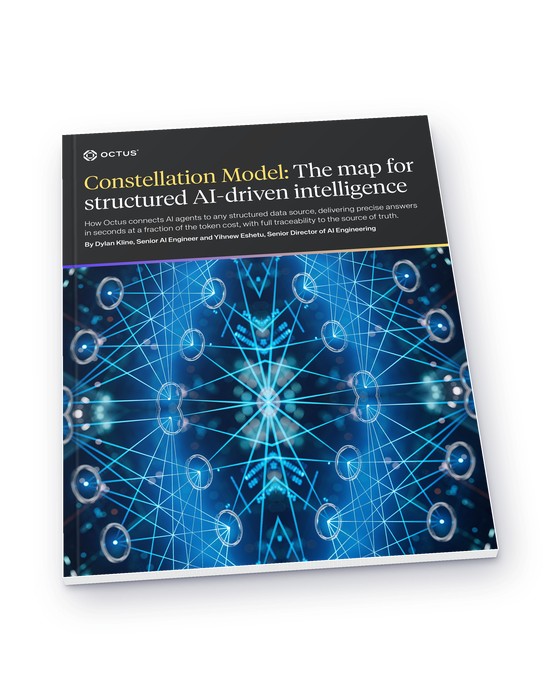
Give your AI agents a validated map of our credit data
The Octus Constellation Model is a semantic layer for AI agents. It routes each question straight to the answer in seconds and shows its work.
Agents that explore data by trial and error burn tokens, run slowly and leave no audit trail. Across 131 benchmark questions, the Constellation Model answered 87 to 91% at 27 to 81x lower cost than raw API agents. Every answer traces to its source.
See how we built it.

“Codifying domain knowledge into a versioned semantic layer enables external agentic systems to reliably reduce complex intent into targeted, validated data routes. That bridge between raw credit data and lightweight client consumption is what makes scalable, trusted AI intelligence possible.”
— Sreekanth Mallikarjun, Ph.D.
Chief Scientist, Head of AI and Data Science
Octus
Inside the benchmark: 131 questions, six runs, one audit trail
Learn how we connect AI agents to financial data without letting them improvise queries. The white paper covers:
- Cost and speed: $0.0054 to $0.035 per question and a 4.5 to 9.5 second median.
- How the map works: The model only picks validated blocks. A compiler writes the SQL or API call.
- No silent wrongs: It declined 12 to 17 of 131 questions per run instead of guessing.
- Worked example: One advisor market share question hides five decisions.
- Onboarding: A new data source reaches the Octus MCP Connector™ in under four days.
See the Constellation Model at work in the Octus MCP Connector
Connect the Octus MCP Connector™ to Claude, ChatGPT, Perplexity and other AI platforms, or to your own agents, and ask questions in plain business terms.
The Constellation Model routes each one to the right data and returns the answer with its audit trail. More connections are on the way.