
See the whole CLO market at once
CLO Data Buyer's Guide
CLO managers and investors often work from partial, disconnected data and intelligence. This guide walks through where CLO market data typically breaks down, questions to help evaluate vendors and how to close the gap.
The CLO market doesn’t wait for your data to catch up
A CLO manager prices tranches against comparable deals that priced hours ago, not last quarter. A CLO investor decides whether to buy into a deal by judging the health of hundreds of underlying loans, most of them issued by private companies with no public filings.
Both are making high-stakes calls on a market that resets daily, using data that often lags by weeks and comes from disparate sources. When the numbers arrive late or don’t reconcile, managers get repriced mid-syndication and investors misjudge the risk they’re actually holding.
The blind spots hiding in most CLO data
For managers
- Private issuers get skipped: Most of the loans backing a CLO come from private companies with no public filings. The fundamental performance data investors need to judge portfolio risk often doesn’t exist anywhere public, so most vendors simply leave it out.
- Pricing runs on stale comps: A manager pricing a new deal needs to see where comparable tranches are trading right now. Without that, pricing gets set on outdated comps and reset by investors mid-syndication.
- Managers spend syndication windows guessing where they stand: Early-look periods typically run about a week and syndication windows about one to two weeks. Managers preparing investor materials or an investment committee memo often don’t have a live view of how they compare to competing managers until it’s too late to adjust the pitch.

For investors
- The liability side goes unseen: Timing a refi, reset or new issue means reading the liability side too: tranche spreads, coverage test cushion and payment waterfall, alongside the underlying loan performance. Most tools show only one side of that ledger.
- Investors juggle a portfolio of managers without a shared yardstick: Investors tracking exposure across many managers need a consistent way to isolate the riskiest, typically CCC-rated, slice of each portfolio and watch for a manager’s style drifting over time. Most tools only show a single snapshot, not the drift.

For investment bankers
- Warehousing risk is a black box: Banks finance and hedge loans on their own balance sheet while a CLO ramps up, often without a live read on what they’re actually holding.
- Arranger standing gets stitched together by hand: Comparing deal terms, pricing and league table position against other arrangers is a manual, deal-by-deal exercise.
- Sourcing the right investors takes guesswork: Placing a tranche means knowing who already holds comparable positions, but that picture is scattered, leaving syndicate desks cold-calling.

“Octus is easy to use; quick platform, concise data.”
Why the usual workarounds still leave a hole
Firms typically patch this gap with some combination of the following, and each one leaves a hole:
- Editorial-only newsrooms break primary and secondary market news well but carry limited data on the loans behind a CLO, so headlines arrive without the performance context to act on them.
- Standalone data providers compete on the breadth of financial metrics they cover but often ship with limited depth, filtering or visualization, so it’s difficult to make the data work at scale. They rarely provide both transaction-level details and complete issuance coverage, and they frequently leave out private credit information altogether.
- New-issue data aggregators capture pricing and structure at launch, then stop tracking the issuer through the rest of the loan’s life and typically carry no CLO holdings data at all.
- Cash flow and workflow modeling platforms: long-established and widely used for structuring and modeling payment waterfalls, but built to model the structure, not to capture fundamental performance data on the loans inside it or deliver market color across managers.
- Manager-supplied data: When an investor leans on a manager’s own analyst output (common when both sit inside the same firm), the data is incomplete because no manager owns every position in the market, and inconsistent because every analyst normalizes and updates on their own schedule, and it can raise information barrier questions when private-level issuer data crosses from one side of the firm to the other.

What good looks like
Before you evaluate any vendor, including Octus, here’s where to focus.

The underlying data
- Does it aggregate fundamental performance metrics on the underlying loans, not just report on the CLO tranche itself?
- Does it cover private issuers as well as public ones? Most of the loans backing a CLO come from private companies, so this is where most gaps hide.
- Can you see both current and historical data, so you can judge a snapshot and a trend?

The scenarios that actually test a platform
- Does the vendor track an issuer through the full loan lifecycle, origination, amendments, refis and repayment, not just at launch?
- Can you search holdings loan by loan, not just at the aggregate manager level?
- Can you see the liability side too: tranche pricing, coverage test cushion and payment waterfall, alongside collateral performance?

Breadth of the market
- How many CLOs and managers does it track, across the US and Europe?
- Does the breadth match your universe: broadly syndicated, middle market and private credit CLOs alike

How the data reaches you
- Can data flow into systems you already use, Excel, Snowflake or Databricks, rather than living only in one interface?
- Is there a dedicated reporting team delivering real-time market color and scoops, not just static data refreshes?
- Can you benchmark against a custom peer set you define, not just a fixed, generic index?
Your "good" checklist
For managers
Proving your position
- Can you show how you stack up against other managers or the broadly syndicated loan market on weighted average revenue growth, leverage and coverage, not just your own book in isolation?
- Can you cut that comparison by any portfolio stratification, price, rating or sector, the way you’d actually present it to investors or your investment committee?
- Does the platform help you track competing CLOs and managers, so you know where you sit before your next investor conversation, not after?
For investors
Reading risk and manager style
- Can you isolate the riskiest slice of a portfolio, the CCC-rated names, rather than only seeing a weighted average that smooths the risk away?
- Can you track a manager’s style drift over time, not just a single snapshot of where their portfolio sits today?
- Does the data help you get ahead of a price or rating change instead of reacting to it after the fact?
For investment bankers
Structuring and placing deals
- Can you see which deals are warehousing loans and moving toward pricing before they reach the wider market, not just after launch?
- Can you benchmark a proposed tranche’s spread and terms against live comps across the whole market, not just a handful of recent deals?
- Does the platform rank arrangers alongside managers, so you know where your desk stands before your next pitch?
What it looks like when the data finally catches up
Close the data and delivery gaps and the change shows up in day-to-day work, not just the pitch deck.
A pricing call, a portfolio review or an investor conversation starts from the same real-time picture of the market instead of a patchwork of reports that were already stale when they landed.
- You stop reacting to old news: A trading or pricing decision reflects where the market is right now, real-time scoops and fresh comps, not where it was when the last report ran.
- You see both sides of the deal at once: The loans behind the CLO and the tranches on top of them show up in the same place, so a coverage test cushion tightening shows up before the next trustee report does, not after.
- You catch drift while it’s still early: A portfolio quietly getting riskier, or a manager’s style quietly shifting, shows up in the data over several quarters instead of arriving as a surprise in one.

Your ideal state

What you can now prove
- Walk into an investor call or an IC meeting with your book already benchmarked against the market, not just against your own history.
- Price a new tranche against where comparable deals are trading today, not where they were trading last month.
- Know where you stand against competing managers before the syndication window closes, not after.

What you can now see
- Pull up the CCC concentration and tail risk in any manager’s book on demand, instead of waiting on that manager’s own reporting schedule.
- Catch a manager’s style drifting before it shows up as a downgrade.
- Build conviction on relative value across managers from the same underlying data, not five different self-reported summaries.

What you can now act on
- Walk into a pitch with the pipeline and pricing already benchmarked against the market, not just your desk’s own recent deals.
- Structure and place a new tranche against where comparable deals are trading today, not last month’s comps.
- See who holds a position before you pick up the phone, sourcing your next mandate from managers and investors already active in the space.
Where Structured Finance Insights fits in
Octus built Structured Finance Insights by pairing our fundamentals data with the CLO news and research reporting team, so one product meets the standard above with trusted data and intelligence.
That starts with the data itself.
Structured Finance Insights aggregates fundamental metrics, including net leverage, revenue growth and interest coverage, with current and historical data, so you can judge a snapshot and a trend rather than one alone.
It holds up in the harder scenarios too: issuers are tracked through the full loan lifecycle, from origination through amendments, refis and repayment, and holdings can be searched loan by loan rather than only at the aggregate manager level.
The liability side comes into view with tranche pricing, coverage test cushion and payment waterfall, alongside collateral performance, so new-issue teams can benchmark proposed spreads against live comps and investors can watch structural protections in real time rather than on a manager’s reporting schedule.
On breadth, coverage spans more than 2,250 US and 700 European CLOs, aggregated from around 3,300 public and private companies, the largest data set of its kind in the market.
It spans the managers and structures our clients are already active in, so benchmarking against the market means the whole market, not a partial sample.
The data also moves into the systems you already use rather than living in one interface, custom benchmarks can be built against any peer set you define, and the same product carries our CLO intelligence: real-time scoops, league tables and people moves from reporters who consistently break primary and secondary market news ahead of the wider market.
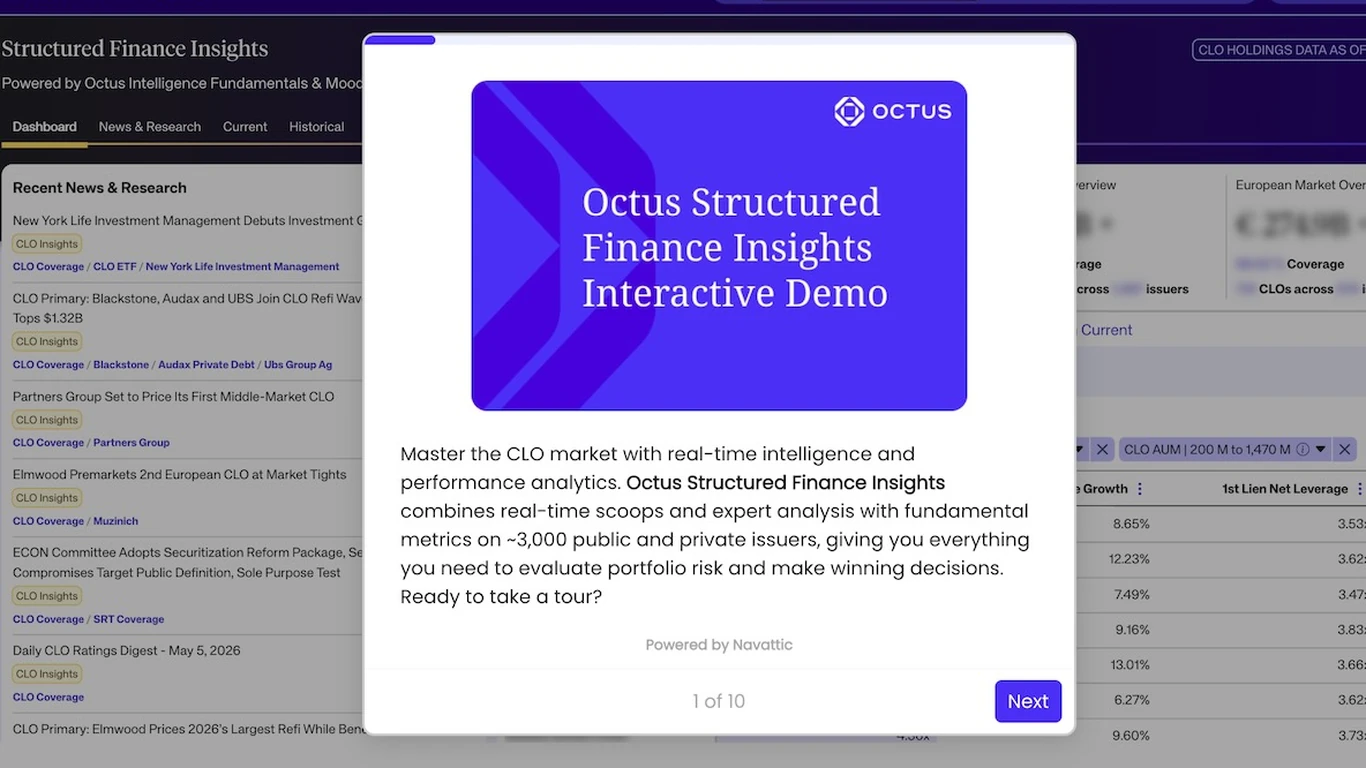
Gain absolute clarity on the CLO market
For managers
Filter by rating or sector to isolate the CCC end of a portfolio, where tail risk actually lives, instead of reading a weighted average that smooths it away.
Track a manager’s metrics over time so style drift shows up in the data before it shows up in performance, giving you a head start on price and rating moves rather than a reaction to them.
“Structured Finance Insights reshaped our ability to understand the market and position our portfolio effectively. — Senior Portfolio Manager, Global Asset Management Firm

For investors
Filter by rating or sector to isolate the CCC end of a portfolio, where tail risk actually lives, instead of reading a weighted average that smooths it away.
Track a manager’s metrics over time so style drift shows up in the data before it shows up in performance, giving you a head start on price and rating moves rather than a reaction to them.

For investment bankers
Follow the warehouse tracker and pipeline pulse to see which deals are warehousing loans and moving toward pricing before the wider market catches on, and search holdings loan by loan to know exactly which managers and investors hold a position.
League tables rank arrangers alongside managers by deal volume and structure, so you walk into your next pitch knowing where your desk stands instead of guessing.

Sample Octus comprehensive CLO data, intel and analysis
Uncover hidden risks and opportunities in the CLO market with granular data, robust analytics and expert reporting.