Data Drops
Diverse par subordination levels in nascent European private credit CLO market draws contrast with the BSL world
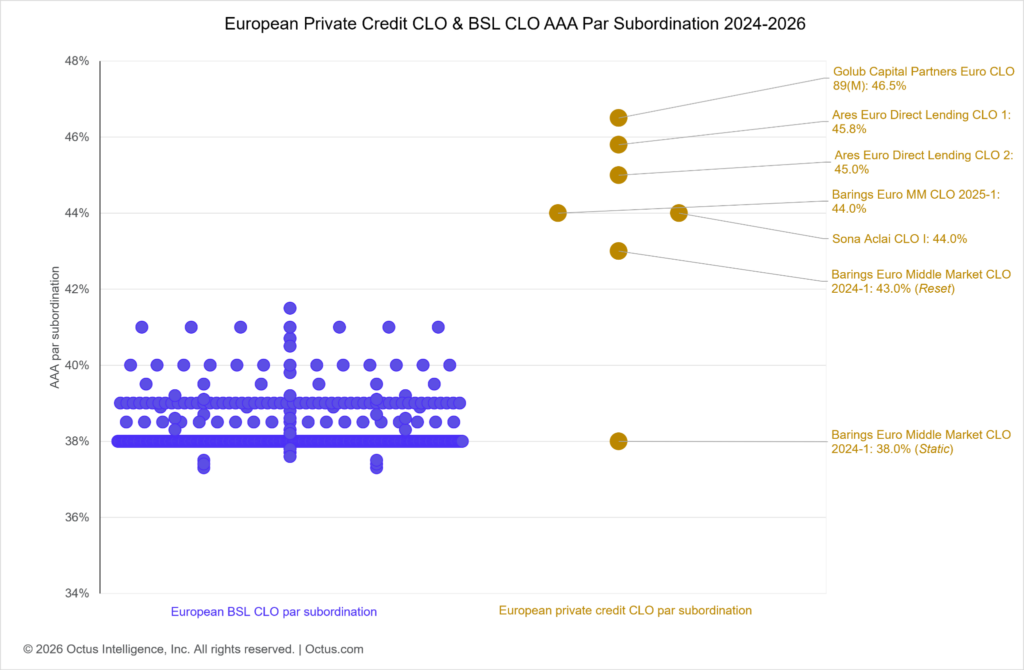
Private credit CLO issuers in Europe are offering investors a far greater degree of variation in the amount of triple-A par subordination than is available in the market for CLOs backed by broadly syndicated loans, Octus has found.
The typical par subordination for a triple-A tranche of a European BSL CLO in recent years sits at 38%, with very few outliers.
Private credit CLOs are a newer invention that were introduced to the European market just under two years ago. The first private credit CLO in Europe, Barings Euro Middle Market CLO 2024-1, priced with triple-A par subordination of 38%, in line with the BSL standard, since it was originally structured as a static deal which typically offer lower par subordination as there is less opportunity for collateral quality to drift over time.
Since reinvesting private credit CLOs were introduced in 2025, deals structured with a reinvestment period consistently show a material lift above BSL par subordination, at a weighted average of 43.6%. After Barings Euro Middle Market CLO 2024-1 was reset into a reinvesting structure in June, it kept the lowest triple-A par sub level of any European private credit CLO, at 43%. Golub’s inaugural European CLO offered the highest par sub at 46.5%.
Par subordination refers to the amount of protection a specific tranche has from the collateral, based on the CLO’s target par amount, which is a rough indication of the amount of losses a portfolio could incur before the tranche would be impaired. Private credit CLOs have less overlap in names in their portfolios between managers, but have fewer names in any given CLO, resulting in both higher par subordination overall and more dispersion between individual deals.
This publication has been prepared by Octus Intelligence, Inc. or one of its affiliates (collectively, "Octus") and is being provided to the recipient in connection with a subscription to one or more Octus products. Recipient’s use of the Octus platform is subject to Octus Terms of Use or the user agreement pursuant to which the recipient has access to the platform (the “Applicable Terms”). The recipient of this publication may not redistribute or republish any portion of the information contained herein other than with Octus express written consent or in accordance with the Applicable Terms. The information in this publication is for general informational purposes only and should not be construed as legal, investment, accounting or other professional advice on any subject matter or as a substitute for such advice. The recipient of this publication must comply with all applicable laws, including laws regarding the purchase and sale of securities. Octus obtains information from a wide variety of sources, which it believes to be reliable, but Octus does not make any representation, warranty, or certification as to the materiality or public availability of the information in this publication or that such information is accurate, complete, comprehensive or fit for a particular purpose. Recipients must make their own decisions about investment strategies or securities mentioned in this publication. Octus and its officers, directors, partners and employees expressly disclaim all liability relating to or arising from actions taken or not taken based on any or all of the information contained in this publication. © 2026 Octus. All rights reserved. Octus(TM) and the Octus logo are trademarks of Octus Intelligence, Inc.