Blog Post
Where Credit Managers Draw the Line: Sin Stock Screening in Leveraged Credit and CLOs
By: Scott Plumridge
Sin Stocks are the companies whose revenue comes from activities that a meaningful body of investors would not fund based on principle rather than on credit grounds; those that make money from exploiting vices. The category conventionally covers alcohol, tobacco, gambling and adult entertainment, meaning pornography and prostitution.
The term ‘sin stocks’ is borrowed from the equity market and in leveraged credit these are obligors rather than stocks. However, the category is still as important in the leverage market, with evidence that sin stocks are more likely to rely on debt financing due to debt markets being less exposed to public scrutiny than equity markets.1
All four sin categories predate ESG and in most cases predate the modern leveraged loan market. Screens of this kind date back to the 18th century, when Quakers withdrew business from firms involved in alcohol, tobacco or gambling; so-called sinful behavior, with issue-specific screening including boycotts of companies tied to the slave trade. Similarly, the first externally screened U.S. investment fund, the Pioneer Fund of 1928, applied negative screens against tobacco and alcohol, making it widely recognized as one of the earliest pioneers of socially responsible investing (SRI) in the United States.2 Although defense can sit within this grouping, shifts in the defense industry over the last few years have meant it warrants separate treatment.
While these four categories share an early history in ethical screening, modern CLO documents (of which we have reviewed over 600) and screening data (for companies in the broadly syndicated loan (BSL) and high yield bond (HYB) markets) reveal distinct differences in how each is treated across the Octus universe. The approach to each category is detailed below, beginning with Tobacco.
Tobacco
Tobacco appears in 82% of CLO documents in the Octus universe, making it the most commonly screened of the four sin stock categories, which is a driver that is largely institutional rather than reputational.
It is the only one of the four backed by a binding international instrument: the WHO Framework Convention on Tobacco Control (FCTC), ratified by 183 parties since 2005, which requires governments to protect public health policies from the commercial and vested interests of the tobacco industry. The FCTC helped transform tobacco exclusion from a public health objective into an established investment norm. That shift is reflected in initiatives such as the Tobacco-Free Finance Pledge3, which has attracted more than 200 signatories representing over USD 17.5 trillion in assets under management, as well as divestment decisions by major pension funds and insurers. Notable examples include CalPERS’ decision to divest $525 million of tobacco holdings in 2000 and subsequently extend the restriction to externally managed funds4, Norges Bank’s divestment of €1.8 billion in tobacco-related companies in 20105, and AXA’s sale of €1.8 billion of tobacco investments in 2016.6 By 2020, this investor-led norm had been codified into financial regulation through Article 12 of Commission Delegated Regulation (EU) 2020/1818, which requires administrators of EU Paris-Aligned Benchmarks (PABs) to exclude companies involved in tobacco cultivation and production, alongside controversial weapons, certain fossil fuel activities and serious violations of the UN Global Compact and OECD Guidelines.7
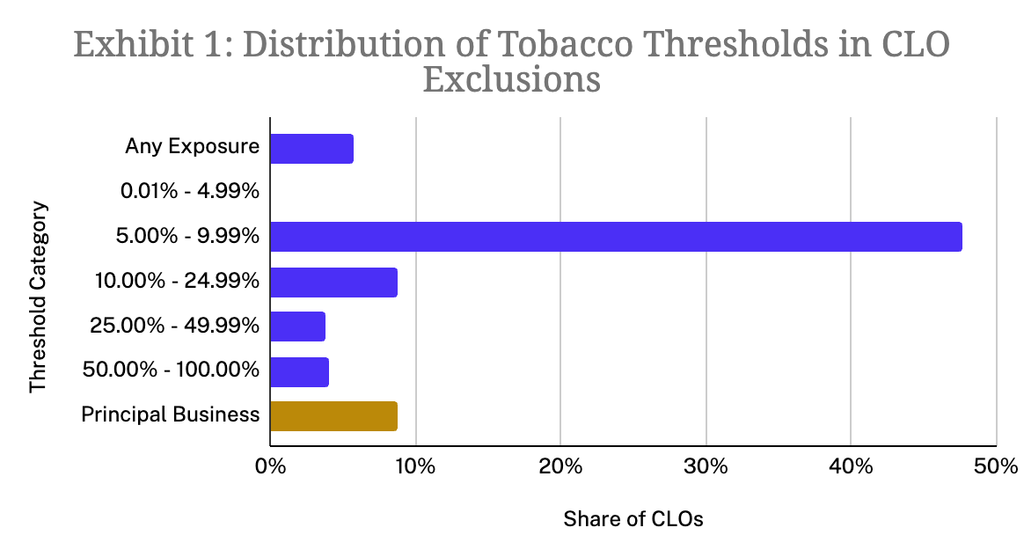
The most common tobacco test is a 5% revenue threshold, found in 48% of documents with a tobacco exclusion, which represents the CLO standard for tobacco exposure. 64% of documents with a tobacco exclusion specify a revenue percentage, more than any other sin stock (Gambling 30%, Adult Entertainment 29%, Alcohol 19%), making it the most revenue-driven. Documents without a revenue percentage fall into separately reported groups like principal business tests, sector classification tests and activity exclusions.
Source: Octus Sustainability 360
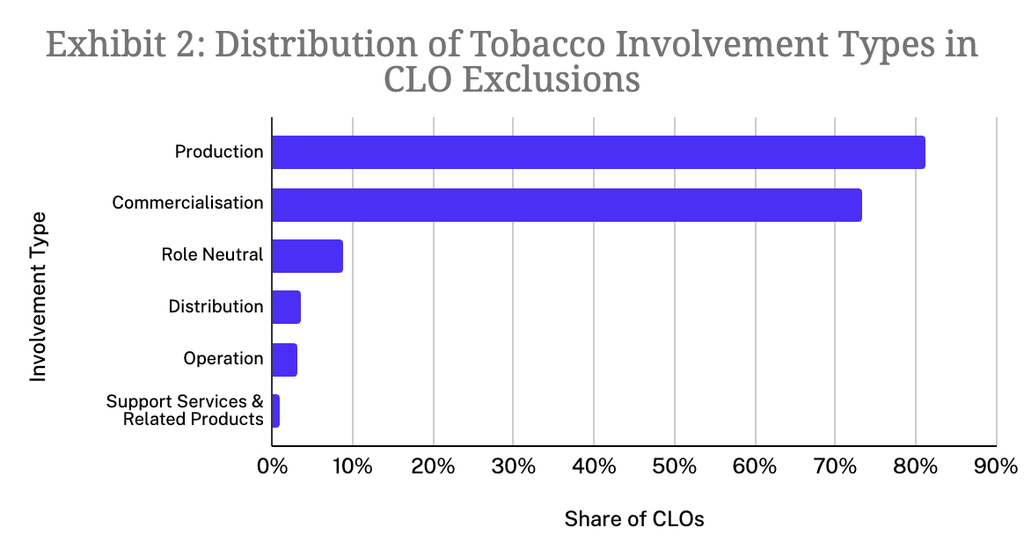
Tobacco exclusion drafting usually specifies the nature of the obligor’s involvement. Production is named in 81% of documents with a tobacco exclusion, and commercialization (trade, sale and retail) in 73%. Other activities such as distribution, operation and support services each appear in less than 5% of the documents, as seen in Exhibit 2.
Source: Octus Sustainability 360
Where managers distinguish between activities, they are consistently stricter on production than on commercialization. Some deals make this explicit through tiered thresholds within a single deal – one pairs a 1% limit on revenue from the obligor’s production of tobacco with a 10% limit on revenue from retail sales; another sets production at zero tolerance, retail at >5% and trade at >50%. The pattern is the same in each case: the closer an obligor sits to manufacturing the product, the less revenue it’s permitted before triggering exclusion. Sector classification tests appear alongside revenue or activity tests, functioning as an additional layer on the same involvement-based structure rather than a separate screening approach.
Based on the Octus Activity-Based Screening data coverage completed to date, tobacco exposure is almost entirely downstream, with the majority of companies involved under commercialization (trade, sale, retail) through forecourts, supermarkets and travel retail, rather than production. Disclosure is the weakest of any category other than adult entertainment, with most revenue assessments being estimated and two-thirds sitting at incidental exposure (0.01%-4.99%).
Industrial suppliers are identified in the data and show what a support services limb looks like in reality. For example, the manufacture of cigarette and filter papers, production of speciality papers or the making of conveyor belting used in tobacco processing lines. A clause naming only production and commercialization leaves a conveyor belt manufacturer serving the tobacco industry entirely outside the screen.
Gambling
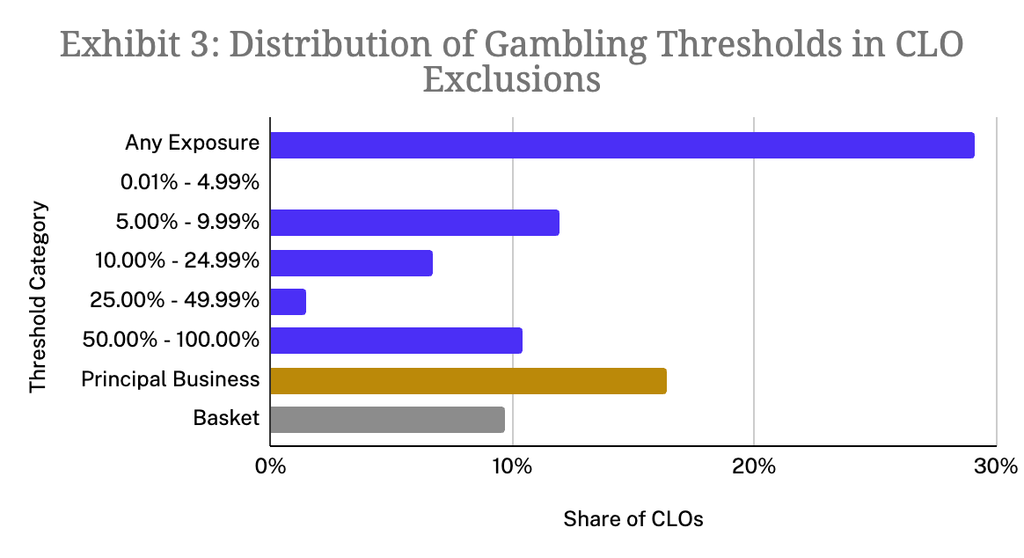
Gambling screening mechanisms appear in 22% of the offering memoranda in Octus’ CLO universe. Although the distribution leans toward lower thresholds, with Any Exposure and 5% thresholds collectively forming the largest cohort of approaches, screening practices remain varied, with 16% of CLOs applying Principal Business tests and about 10% adopting 50% pure-play thresholds.
Source: Octus Sustainability 360
What differentiates Gambling from the other sin stock categories is how a number of CLOs do not rely exclusively on revenue thresholds or outright exclusions. Instead, nearly 10% of gambling-excluding offering memoranda include a portfolio basket, allowing otherwise prohibited exposure up to a defined share of the portfolio, typically 5%.
Unlike revenue thresholds, which measure how much revenue an obligor derives from gambling activities, basket mechanisms limit the CLO’s aggregate exposure. Effectively, a revenue threshold screens the company while a basket limits the portfolio. A company barred by a revenue threshold can never be purchased, whereas a company inside a basket can be held until the basket is exhausted.
The presence of baskets and occasional distinctions between regulated and unregulated gambling activities demonstrates that gambling exclusions are not applied uniformly across the CLO market. While most managers screen gambling as a broad exclusion category, a small number of documents permit limited exposure through portfolio baskets or focus specifically on unregulated gambling activities, typically referring to the U.K.’s Gambling Act 2005 or using explicit carve-outs for licensed lotteries.8 These variations highlight differences in how managers define and scope gambling-related restrictions.
Gambling is also the only sin stock category where screening data and the offering memoranda restrictions show alignment. Across the assessed universe, 66% of gambling-involved companies were based on reported data, which is double the disclosure rate of Alcohol and five times that of Tobacco. This largely reflects industry concentration, with nearly half of gambling-flagged companies deriving a majority of their revenue from gambling activities, making disclosure unavoidable as exposure is a core part of the business. The remaining companies under the gambling flag tend to derive only tangential revenue through payments infrastructure, workforce software, credit data and forecourt lottery terminals, with some companies flagged not for direct gambling operation, but for support services.
The presence of baskets and of regulated-versus-unregulated carve-outs shows how some managers treat gambling as a traditional ethical exclusion, whereas others treat it as regulatory, legal and conduct risk. This helps explain why gambling is the only sin stock category in which managers employ both permitted baskets and regulated-versus-unregulated carve-outs.
Alcohol
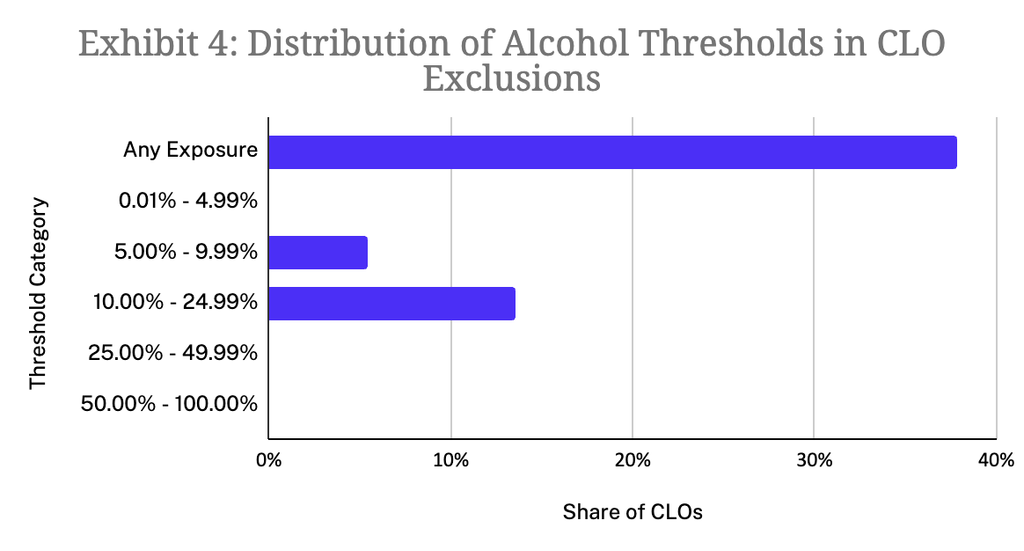
Alcohol is the least frequently excluded ‘sin stock’, found in just 6% of the CLO documents. Just 10 asset managers in our universe have an Alcohol exclusion. Three of which are solely responsible for the ‘Any Exposure’ threshold, representing 38% of the alcohol-excluding documents.
Source: Octus Sustainability 360
These statistics describe the preferences of a small group rather than a market standard, but do provide insights into the preferences of those within the Octus universe which mainly serves European and US managers.
The assessed Activity-Based Screening universe shows an inverse picture to that painted by the document data, with Alcohol being the least excluded sin stock but the most frequently flagged screen in the current covered universe, just ahead of both gas and oil. Tobacco is almost the reverse, present in 82% of documents and only the eighth most prevalent.
Just over three-quarters of the companies have incidental exposure to alcohol, sitting between 0.01% and 4.99% of revenue and one-third of the alcohol dataset is disclosed and reported data. Exposure is majority downstream, with 80% of companies sitting under commercialization, meaning on-site retail and hospitality rather than production. Flags cover hotel and cruise bars, cinema and theme park licensed premises, catering and entertainment venues, forecourt off-sales and grocery stores. Our data only captures a couple of companies involved in production with one satisfying every sub-criterion of our alcohol producer definition: brewer, vintner, distiller and vineyard owner.
So why is there so little drafting for so much exposure? This is because there is no equivalent of the FCTC, no alcohol limb of the PAB and where alcohol restrictions are institutionalized, they are more commonly found in investment frameworks that have explicit religious or ethical mandates, particularly Shari’ah-compliant funds, Christian-based investment strategies and some endowments or charities with temperance-related traditions.9
AAOIFI Shari’ah Standard No. 21 (Shares and Bonds), for example, serves as the global guideline for assessing investments under Islamic law, and permits only limited exposure to noncompliant activities.10 However, because the CLO market remains predominantly European and U.S. in composition, these screening traditions are not reflected in the broader market. Hence why alcohol is one of the most common exposures in the universe while remaining one of the least common exclusions in CLO documentation.
Adult Entertainment
Adult Entertainment is the only sin stock in the screening data that does not overlap with the others. The other three categories cluster on shared premises, forecourts, supermarkets and casino resorts selling alcohol, tobacco and gaming across a single counter, with adult entertainment commonly delivered via distribution networks – positioning it as an activity that other sin stock clauses rarely reach, aside from live entertainment.
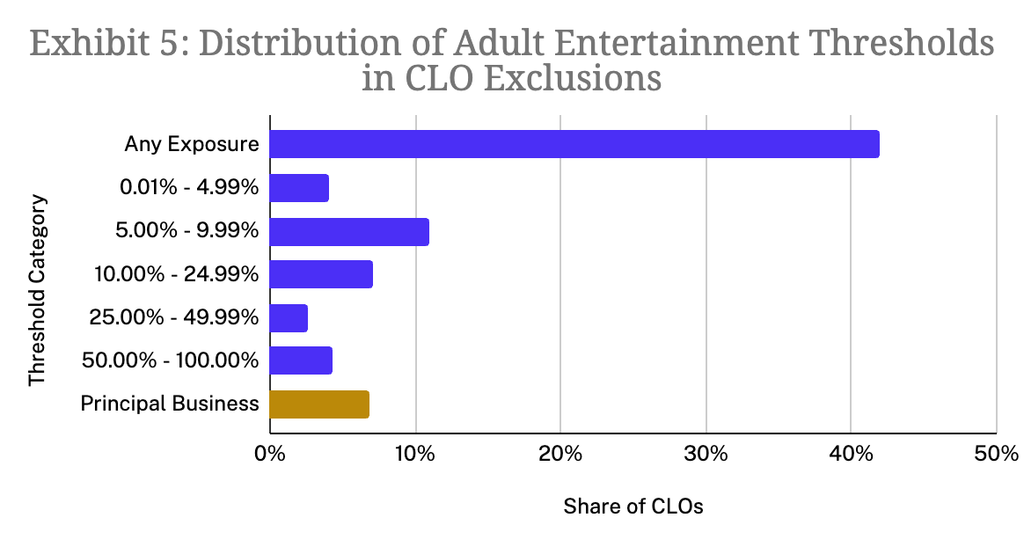
Adult Entertainment exclusions are evident in about 76% of Octus’ universe of CLO offering memoranda, mostly identified in these documents under the grouped labels of ‘Pornography’ and ‘Prostitution’. The category is predominantly complete-exclusion driven, with Any Exposure exclusions dominating at 42%, more than any other sin stock category.
Source: Octus Sustainability 360
The screening data shows that almost all companies in our universe involved in Adult Entertainment sit in the GICS Communication Services sector (50) under Telecommunication Services (5010), with some in Media & Entertainment (5020) and Consumer Discretionary Distribution & Retail (2550). Most of the companies are flagged because their television packages include adult pay-per-view channels, and almost all are flagged for distribution as the involvement type. The data reveals that these companies are incidentally involved, and as they do not disclose their involvement or revenue, our estimation analysis has placed them between 0.01% and 4.99% revenue attribution.
Although pornography and prostitution are predominantly bundled together in the document drafting, the way the two limbs are classified differs. The CLO documents identify various involvement types for pornography, such as the manufacture, trade, sale and distribution, whereas the prostitution limb of an exclusion clause names no involvement type, but simply the activity itself, which leaves little to attach a revenue percentage to. Role-neutral clauses like this have the widest scope, as they are not limited to an involvement type and simply exclude the entire activity. Only a handful of examples were found of where these activities were split, and in these cases, prostitution was the stricter clause, for example, “(j) derives more than 5 per cent of its revenue from the trade in, production or marketing of pornography” against “(m) derives any revenue from prostitution”.
Overarching Commentary
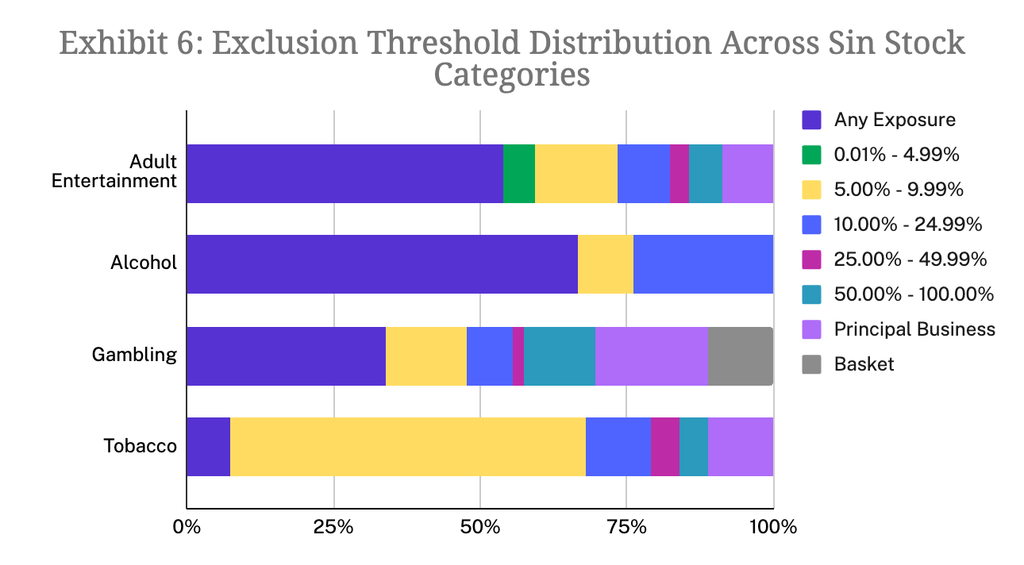
While thresholds vary by category, CLO screening approaches generally cluster around Any Exposure exclusions and low revenue thresholds. Beyond these stricter approaches, the distribution becomes more fragmented, with a mixture of intermediate thresholds, pure-play tests and qualitative exclusions without explicit revenue limits.
Source: Octus Sustainability 360
Tobacco is commonly screened using revenue thresholds, with 64% of deals only excluding issuers that exceed a specified revenue level. Adult entertainment is screened by absolute prohibition, with complete exclusion at Any Exposure, in 42%. Exhibit 6 highlights the inverse relationship between Any Exposure and 5% thresholds in the two categories, with tobacco concentrated in the latter and adult entertainment in the former. This demonstrates how the two categories are treated differently in CLO screening practice, with tobacco being drafted as a normative exclusion with a de minimis allowance, and pornography and prostitution more often drafted as reputational absolutes, where the objection is to any association at all rather than to a quantity of it.
A 50% revenue threshold functions as a pure-play test, and its practical effect differs sharply by category. In adult entertainment, it is inoperative as all flagged companies sit below 5% revenue, and no obligor deriving a majority of its revenue from pornography or prostitution appears in the leveraged loan market. Alcohol and tobacco sit mostly at incidental exposure too, though pure-play companies do exist in both.
Gambling is the exception here, where, within the currently assessed population, almost half of the companies flagged for the screen derive a majority of their revenue from gambling activities. For gambling, the 50% revenue test is a live constraint on a large proportion of the population, which is consistent with 10% of gambling-excluding documents adopting it. A high revenue threshold is mostly inoperative where exposure appears incidentally through a diversified business, but operative in a population containing genuine majority-revenue companies that issue debt in the market.
Within GICS 2530, the Consumer Services block that covers hotels, restaurants, casinos, gaming and leisure facilities, every company assessed to date within the Octus Activity-Based Screening universe carries at least one sin stock flag. The companies that flag for three screens can be broadly divided into two business models: forecourt & convenience retail, and casino resorts. In both cases, alcohol, tobacco and gambling exposure arises through products and services offered within a single location. This highlights how multi-screen exposure in leveraged credit is often a premises-based phenomenon rather than a diversified-business-model one, driven by what is sold across a single counter or property, rather than by diversified group structures.
This distinction between core and ancillary activities is also reflected in issuer disclosure. As expected, disclosure is generally present where the screened activity constitutes a primary line of business, but becomes far less visible where exposure is incidental. Across all four categories, incidental exposure is rarely disclosed explicitly, regardless of the nature of the activity itself.
Looking across both the document review and the screening data, the data demonstrates that the four traditional sin stock exclusions are not applied according to either the scale of harm they are perceived to cause or their prevalence in the leveraged credit market. Tobacco appears in four-fifths of CLO documents, despite relatively limited issuer exposure, because its exclusion is reinforced by a combination of factors that none of the other categories possess: an international treaty, benchmark regulation and over two decades of institutional divestment. Alcohol, on the other hand, is one of the most common exposures in the Octus company universe, but appears in only a small minority of CLO exclusions, reflecting the rationale of the exclusion and the absence of comparable regulatory or institutional pressure.
Gambling remains largely a values-based screen, although the use of baskets and carve-outs for licensed or regulated activities demonstrates that the exclusion objective can be implemented in different ways, with some managers incorporating regulatory distinctions alongside traditional screening criteria. Adult entertainment remains the clearest example of a value-based and reputational screen, with many offering memoranda applying an Any Revenue test despite the near absence of majority-revenue issuers in the BSL and HYB market.
Sources:
- Science Direct | The Price of Sin in the Pacific Basin
- American Enterprise Institute | The Myth of Social Investing
- UNEP FI | The Tobacco-Free Finance Pledge
- LA Times | State Pension Fund Votes to Divest Tobacco Stocks
- Responsible Investor | Norwegian Fund Sells off Euro1.8bn in Tobacco Shares after Government Ban
- AXA | AXA Group Divets Tobacco Industry Assets
- European Commission | Commission Delegation Regulation (EU) 2020/1818
- UK Parliament | Gambling Regulation in Great Britain
- The Church of England | Ethical Exclusions
- AAOIFI | Sharia’ah Standards
This publication has been prepared by Octus Intelligence, Inc. or one of its affiliates (collectively, "Octus") and is being provided to the recipient in connection with a subscription to one or more Octus products. Recipient’s use of the Octus platform is subject to Octus Terms of Use or the user agreement pursuant to which the recipient has access to the platform (the “Applicable Terms”). The recipient of this publication may not redistribute or republish any portion of the information contained herein other than with Octus express written consent or in accordance with the Applicable Terms. The information in this publication is for general informational purposes only and should not be construed as legal, investment, accounting or other professional advice on any subject matter or as a substitute for such advice. The recipient of this publication must comply with all applicable laws, including laws regarding the purchase and sale of securities. Octus obtains information from a wide variety of sources, which it believes to be reliable, but Octus does not make any representation, warranty, or certification as to the materiality or public availability of the information in this publication or that such information is accurate, complete, comprehensive or fit for a particular purpose. Recipients must make their own decisions about investment strategies or securities mentioned in this publication. Octus and its officers, directors, partners and employees expressly disclaim all liability relating to or arising from actions taken or not taken based on any or all of the information contained in this publication. © 2026 Octus. All rights reserved. Octus(TM) and the Octus logo are trademarks of Octus Intelligence, Inc.