Weapons Screening in the Rearmament Era: Rethinking Defense Exclusions in Responsible Investment
By: Scott Plumridge

Key Points
- European rearmament is accelerating at a pace not seen since 1953.
- Landmark EU programs have unlocked over €800 billion in potential defense investment across the bloc.
- Responsible investment frameworks clarify that defense is not barred.
- Many credit instruments enforce broader restrictions than regulations require.
- Institutional investor stances are diverging, with nuclear investment permitted and dedicated defense investment vehicles launched.
- Material defense involvement sits undetected across diverse supply chain industries.
Global stability is undergoing a profound transformation, pushing military readiness and defense capabilities to the forefront of national and financial agendas – and triggering a fundamental shift in how the defense sector is treated within institutional portfolios. Before 2022, the defense sector had been sidelined by investors, as ESG screens, responsible investing mandates and ethical frameworks treated it as incompatible with sustainable investment.1, 2
However, Russia’s full-scale invasion of Ukraine in February 2022 represented a definitive turning point, altering the European security landscape, reinforcing the need for greater defense investment and rapidly reshaping public and investor perceptions of the defence industry.3, 4, 1 In response to this volatile environment, European NATO members have significantly increased defense allocations, with a rate of military budget expansion in 2025 not seen since 1953, marking an era of rearmament across Europe.5
This sudden capital reallocation is driven by the need to rebuild defense capacities and achieve greater strategic autonomy in the face of regional aggression and rising transnational conflicts. Compounding these investment drivers are growing uncertainties regarding the long-term durability of the United States’ security guarantee, particularly as Washington prioritizes domestic military spending and scales back direct support for international allies.6 This landscape mirrors the World Economic Forum’s Global Risks Report 2026, which comments on how stability is “under siege,” characterizes the geopolitical landscape as an “age of competition,” and identifies ‘geoeconomic confrontation’ and ‘state-based armed conflict’ among the most critical short-term threats to international stability.7
Octus CLOs
For credit investors, many collateralized loan obligation (CLO) indentures and fund mandates carry exclusions that predate the current regulatory environment, geopolitical reassessment of defense and evolving interpretation around what constitutes a controversial weapon. Navigating this requires a level of granularity that broad sector classifications cannot provide.
In private credit markets, the constraints on defense investment are at document level. Octus’ insights into the CLO market cover mostly European CLOs, as well as some U.S. funds, spanning a universe of over 500 CLO offering memorandums. Our analysis of active global CLOs during Q4 2025 reveals that about 5% exclude military weapons and defense while 40% restrict investment in firearms, and 35% specifically target civilian firearms and weapons. Over 70% explicitly exclude investment in controversial weapons. Separately, about 10% make specific reference to nuclear weapons and the Treaty on the Non-Proliferation of Nuclear Weapons (NPT), and nearly 15% mention Weapons of Mass Destruction (WMD).

Source: Octus
Our data reveals that there is no market standard for defining prohibited involvement in the defense and firearms sectors. Instead, the CLO offering memorandums use a range of revenue-based thresholds and business activity triggers to differentiate between core manufacturers and companies with peripheral exposure. Quantitative revenue thresholds are the most common and set specific percentage caps on revenue derived from restricted activities.
- Strict Exclusions (0%–5%): These represent the strictest exclusion zones. By setting a zero-tolerance policy for manufacturing or production, these mandates often prioritize absolute avoidance and effectively disqualify any obligor with direct exposure to the sector.
- Materiality Thresholds (5%–10%): These are the most prevalent threshold standards in the documents and serve as a materiality test, allowing for minimal incidental exposure while filtering out companies for whom the sale or production of firearms constitutes a meaningful, though not necessarily core, business segment.
- The 10%–25% Gap: Notably, no CLO offering memorandums in our sample set a threshold within this range. Documents move directly from the 10% materiality ceiling to the 25% broad-activity threshold, leaving a gap in the market’s revenue-based approach to defining prohibited involvement.
- Broad-Activity Thresholds (25%–50%): These caps are generally reserved for broader activities (for example financing, storage, maintenance, logistics or transport) where a company may have incidental exposure to the defence/firearms supply chain, but it is not the primary business function. This allows for the inclusion of service-oriented companies that interface with the defence supply chain without being weapons manufacturers.
Even across CLOs not just confined to ESG and sustainability-labelled or responsible investment vehicles, controversial weapons exclusions appear as a standard feature, irrespective of a fund’s wider mandate, reflecting the conventions that restrict these weapons. Their treatment differs from the incremental, revenue-based thresholds applied to civilian firearms. The threshold is almost universally set at 0% revenue, disqualifying any obligor with any involvement in the sector. The exclusion also rests on a wide-ranging “activity net” that reaches beyond manufacturing to financing, stockpiling, transportation, maintenance, and the provision of dedicated technology. Many CLOs go further still, incorporating a “look-through” ownership exclusion that automatically triggers where an obligor owns 50% or more of a subsidiary engaged in these activities, preventing the corporate structure from being used to bypass such mandates.
The definition of “controversial weapons” varies slightly across these documents, but a common classification across the majority of documents that carry the exclusion, draws on categories prohibited under international treaties or conventions. This definition in the offering memorandums typically includes anti-personnel mines, biological and chemical weapons, cluster munitions, depleted uranium and white phosphorus, with some definitions also referencing radiological weapons and inhumane conventional weapons restricted under the Convention on Certain Conventional Weapons. Some of these documents extend the controversial weapons scope to include nuclear weapons, and a further subset does not use the term “controversial weapons” at all, using “Weapons of Mass Destruction” in its place, a category that itself encompasses radiological, nuclear, biological and chemical weapons. The definition of controversial or prohibited weapons is nonetheless typically wider than the four categories named in SFDR and under the EU’s “prohibited weapons” definition, which excludes nuclear weapons entirely, as expanded upon below in the Regulatory & Industry Section.
Documents that explicitly exclude nuclear weapons often reference the NPT as their primary definitional anchor, however the treatment is not uniform across all offering memorandums. Some prohibit nuclear weapons outright with no reference to the NPT, while others exclude activities in breach of the NPT, and at least one document explicitly carves nuclear weapons out of its Controversial Weapons definition altogether, using phrasing such as “Controversial Weapons (other than nuclear weapons)”. The distinction becomes complex when applied to the five nuclear-weapon states recognized under the treaty (the United Kingdom, United States, France, Russia and China). Article I binds these states to not transfer nuclear weapons or assist others in acquiring them, while Article II binds non-nuclear-weapon states not to receive or manufacture them. Neither provision comments on recognized nuclear states maintaining, securing or investing in their own existing sovereign arsenals. On the other hand, stricter views focus on Article VI, under which all parties commit to pursue negotiations in good faith on effective measures relating to nuclear disarmament. From this perspective, the financing of arsenal modernization programs extends nuclear reliance and works against the aim of eventual disarmament. Under stricter investment mandates, the ongoing maintenance and expansion of these arsenals are treated as inconsistent with these Article VI commitments and such activity is screened out accordingly, even for companies operating in authorized nations.8 By simultaneously tolerating possession and committing parties to work toward disarmament, the NPT creates a paradox. Investment managers are left to judge whether involvement in nuclear weapons constitutes compliant support of sovereign deterrence or conflicts with international commitments.
The Octus Activity-based Screening product addresses these credit constraints by disaggregating defense exposure into distinct categories: “Military Weapons” versus “Civilian Weapons” and “Nuclear Weapons” treated separately from “Controversial Weapons”. The latter split mirrors SFDR’s own architecture, where nuclear weapons fall outside the regulation’s controversial weapons definition, unlike the broader treatment common in CLO documentation, which frequently folds nuclear weapons into the controversial weapons category itself. Separating the two allows investors to apply SFDR-aligned logic where relevant, while still capturing nuclear exposure as its own distinct screening dimension rather than conflating it with treaty-prohibited weapons categories.
By screening at the involvement level rather than relying on a sector-level exclusion approach (which is often too blunt and creates a screening gap), the tool gives investors the precision to make informed decisions without unnecessarily limiting the investable universe. Involvement in defense and weapons occurs across the whole value chain, from production and research and development through to support services and the direct retail sale of weapons. Much of this exposure occurs at the component or sub-system level rather than the manufacture of complete weapons, with examples of flagged activities including optical and laser systems, printed circuit boards, engine maintenance and overhaul, aircraft landing gear, technical ceramics for armour, naval propulsion turbines, ballistic fibre and protective coatings for military vehicles.
Consequently, the tool surfaces a less visible dimension of defense exposure, identifying related companies that sit outside the traditional GICS Aerospace & Defense classification entirely. In fact, a number of companies flagged for “Military Weapons” span categories as varied as electronic components, semiconductor equipment, specialty chemicals, industrial machinery and electric utilities, among others. This underscores how defense involvement, be that through supply chains, dual-use technology or contracted services, is considerably broader than what sector-level classifications capture, meaning companies with material defence involvement may otherwise sit undetected within portfolios, masked by industry codes that imply zero sector exposure.
Our data reveals a significant variance in defense-attributable revenue, highlighting why granularity is so important. At one end of the spectrum, a supplier of aircraft components derived more than 60% of its revenue from the sector, whereas at the other end, a utility’s naval propulsion exposure accounted for about 0.3% of company-wide revenue.
After analysing over 200 CLOs of clients that used our product to produce reports for the 2025 SFDR reporting period, aerospace and defense companies (classified under GICS industry code 20101010), represented 0.43% of SFDR companies and 0.84% of SFDR assets. Despite accounting for a very minor share of the overall SFDR universe, 42% of clients held exposure to the sector during this period, although, as expected, no companies held exposure to PAI 14, Controversial Weapons.9 As the regulatory framework, geopolitical context and classifications around responsible defense investment continue to evolve, Octus Activity-based Screening provides the granularity to navigate the landscape with precision.
Regulation & Industry
Alongside the continent’s push to re-arm, regulatory bodies are actively working to remove administrative barriers and cut the red tape that has previously restricted in-flows of capital into defense-related industries, introducing sweeping reforms and adjusting regulatory frameworks to bolster spending and procurement.10, 11 The EU’s sustainable finance framework has undergone a parallel reclarification, with the SFDR, EU Taxonomy, European Securities and Markets Authority (ESMA), as well as the UK’s Sustainable Disclosure Requirements (SDR) progressively clarifying their positions, confirming that none of these frameworks bar investment in the defense sector and verifying that investments in the defence sector are fundamentally compatible with sustainable finance frameworks.
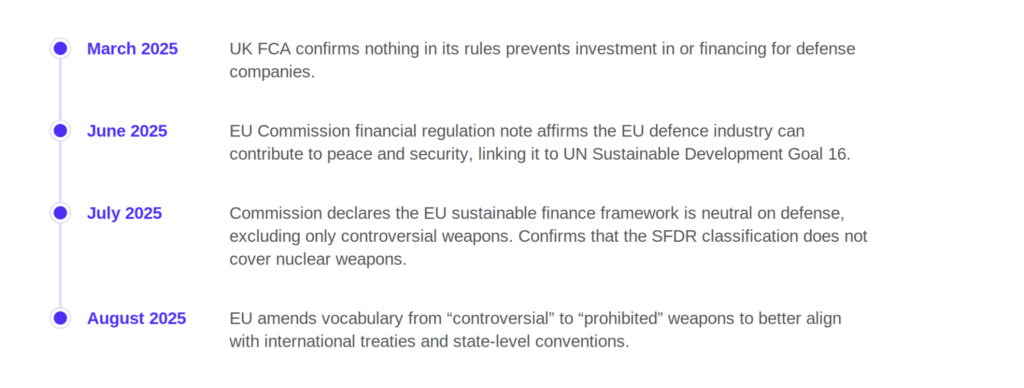
In March 2025, the U.K. Financial Conduct Authority (FCA) stated unambiguously that nothing in its rules, including those governing sustainability, prevents investment in or financing for defense companies, extending this to labelled funds operating under the SDR regime.12 The European Commission issued a congruent clarification in July 2025, confirming that the EU sustainable finance framework, which includes the EU Taxonomy Regulation, Corporate Sustainability Reporting Directive (CSRD), and SFDR, is “neutral with regard to the defence sector,” only singling out specific controversial weapons, as defined in the SFDR. It also explicitly states that “the EU sustainable finance framework is compatible with investing in the defence sector” and that it “sets no limitations on the financing of any sector, including the defense sector”.13
The EU Taxonomy makes “direct reference to the SFDR principal adverse impacts indicators related to sustainability factors”, suggesting the same controversial weapons exclusion applies and no broader defense-related activities are embedded within it.13 Companies and funds engaged with conventional defense remain within scope for Taxonomy alignment assessments on the same terms as any other sector, although to be considered ‘environmentally sustainable’, economic activities must still ‘substantially contribute’ to one of the six environmental objectives and ‘do no significant harm’ to any of the others.14 ESMA’s position remains consistent with both, publishing guidance that confirms controversial weapons exclusions in line with SFDR.15
In June of 2025, the European Commission released a financial regulation note affirming that “EU’s defence industry has the potential to contribute to our common peace and security, in line with UN Sustainable Development Goal 16 – Peace, justice and strong institutions”, framing the sector as a potentially integral part of responsible investment.16 This regulatory position links to the broader geopolitical situation, with an acknowledgement from the Commission that the current regulatory environment was designed in peacetime and is not fully adapted to the security landscape it now contends with.17
Despite this notable shift toward conventional defense, strict boundaries remain regarding specific weapon categories. While these exclusions were previously governed by the SFDR’s Principal Adverse Impact (PAI) indicator 14 under the label “controversial weapons”, the EU moved to amend and standardise this terminology to “prohibited weapons” in August 2025.18 Because international treaties and state-level conventions do not reference the term “controversial”, the previous framing left too much uncertainty and a lack of uniformity for administrators. Under this updated, legally streamlined definition, the excluded categories remain focused on four specific areas: anti-personnel mines, cluster munitions, chemical weapons, and biological weapons.
Crucially, however, nuclear weapons fall outside of this definition entirely, with the Commission’s July 2025 notice explicitly confirming that the SFDR’s controversial (now prohibited) weapons classification “does not cover nuclear weapons”.13 This creates a complex regulatory grey area in responsible defense investing, with some fund managers excluding any company with nuclear weapons exposure, and others permitting investment in firms operating in signatory countries of the 1968 Treaty on Non-Proliferation of Nuclear Weapons (NPT).19
Beyond these regulatory shifts, CLOs remain constrained by their own investment policies, indentures and mandates. Regulatory clarification may remove a perceived barrier but does not override internal frameworks that institutional investors have established around stricter exclusion criteria. Therefore, institutional investors must consider how recasting conventional defense as compatible with sustainable investment risks treating regulatory permission as ethical validation. The International Capital Market Association (ICMA) offers a nuanced position in its June 2025 Guidance Handbook, acknowledging that assessing “sustainability characteristics is not inherently incompatible with investment in defence projects or companies”, but does not explicitly endorse defense involvement, highlighting that the manufacture and trade of weapons raises issues relating to the traceability, end-use destination and compliance.20
Source: Octus
Market Pulse
Defense has emerged as an increasingly active sector in private credit, underpinned by this fundamental regulatory and geopolitical shift. A key catalyst in Europe has been the aforementioned changes to ESG regulations and clarification regarding SFDR-compliant sustainable investments, removing barriers to financing defense assets. Following the EU’s confirmation that conventional defense investment can sit within its sustainable finance framework, investors understand that defense firms are not categorically excluded from ESG-aligned portfolios and increasingly recognize that defense “is necessary for security but also has an attractive return prospect”.21 Some forecasts even suggest that European Defense firms could soon be classed as ESG investments given the urgent rearmament demands.22
Aerospace and Defense is described as being “poised for explosive growth” because many companies remain independently owned or venture-backed, and the influx of government spending has put a spotlight on the sector.23 Private credit deal volume in Software sector has been displaced in favor of sectors better suited to the current environment, including Aerospace and Defense, Industrials, Energy and Healthcare.23 A growing number of private credit funds are also enabling financial sponsors to take on higher leverage to place larger bids for defense assets, with maximum leverage in the sector hovering about 5x, according to Octus Data.24, 25 Octus sources have argued that the long duration capital needs of defense investment mean private capital firms with global scale will play what it calls “the most material role” in funding defense needs over the next 10 to 15 years.26 Defense is described as one of the standout trends driving private credit activity across both the Americas and EMEA markets, and merger and acquisition activity in aerospace and defense has emerged as the highest returning area for funds investing across the broader industrials sector.27, 28, 24 According to our Octus Fundamentals sub-sector market data for a universe of 32 private Aerospace and Defence companies, revenue grew 12.50% year on year with adjusted EBITDA up 11.6% as of the first quarter of 2026.
Beyond private credit, this evolving landscape is driving a noticeable pivot in the wider market. In 2025, with the European Commission, the EIB and national governments actively moving toward capital reallocation into defense as a strategic necessity, some financial institutions began to revise their investment policies. In April, Danske Bank expanded its investment universe for defense companies, citing the new geopolitical reality and shifting investor preferences, and disclosed that its defense-related assets under management had more than doubled over the prior two years.29 In June, Sweden’s largest bank SEB revised its defense policy to permit engagement with companies involved in nuclear weapons activities, with the stipulation that they be headquartered in a NATO member state. The bank also cited the deteriorating security environment in Europe and Sweden’s own recent accession to the Alliance as reasons for this shift.30
A parallel shift has taken place at industry association level in Germany. In December 2024, the country’s fund and banking associations (BVI, BSW, and DK) revised the shared standard used to classify sustainability-labelled products (ESG Target Market Concept/Zielmarktkonzept), removing a rule that had barred funds from investing in companies deriving more than 10% of revenue from defense. Only weapons banned under international law remain excluded under the revised standard.31 The shift did not produce a uniform response. While German Article 8 SFDR funds’ average allocation to aerospace and defense rose from 0.8% at the end of 2024 to 1.3% by mid-2025, individual providers have taken distinctly different routes. Some, particularly those with church affiliations, have kept a blanket exclusion, while others have moved to a reduced threshold or dropped exclusions altogether.32
Norges Bank Investment Management (NBIM), the world’s largest asset owner and sovereign wealth fund, continues to prevent investment in major defense companies through its exclusion list. Boeing, Airbus and BAE Systems are among those prohibited for their involvement in nuclear weapons production, in line with the exclusion framework administered by the independent Council on Ethics since its creation in 2004.33, 34 These exclusions remain but the political environment around them has shifted as multiple right wing parties urge a rethink, citing the war in Ukraine and Norway’s NATO alignment.35 In November 2025, Norway’s government ordered NBIM to pause new ethics-related investment decisions for nearly a year while a committee conducts a formal review of the entire ethical framework, with a report due by October 2026.33, 36, 37 The pause was primarily framed around the security environment and the increasing blurring of military and civilian technology.36 After more than two decades, this political and geopolitical pressure could see the fund’s exclusion criteria relaxed. At the start of 2026, appetite for defense was evident in the equity market, where Europe’s STOXX aerospace and defence stocks index reached a record high on Jan. 8, gaining 13% in the opening days of the year alone.27
In the United States, there is more of a sense of continuity than revision. CalPERS (California Public Employees’ Retirement System), the largest public pension fund in the country, CalSTRS (California State Teachers’ Retirement System), the largest educator-only pension fund in the world and the second-largest public pension fund in the United States, and NYSCRF (New York State Common Retirement Fund) have all maintained defense exposure through passive equity mandates tracking broad indices and none have signalled any formal shift in stance on defense investment specifically. Weapons-related exclusions at CalPERS and CalSTRS have historically focused on banned civilian weapons categories, stemming from the Sandy Hook Elementary School shooting in December 2012, which prompted a two-year divestment process finalized in 2015, rather than restriction on military contractors, which continue to be held passively through index exposure.38 NYSCRF’s responsible investment policy has been mostly focused on the climate transition rather than weapons or security considerations.39
BlackRock’s launch of the iShares Defense Industrials Active ETF (IDEF) in May 2025 showcased a deliberate move away from passive exposure and toward a dedicated thematic vehicle. The product offers exposure to companies at “the center of shifting geopolitical dynamics, national defense strategies and global security priorities”, and is explicitly positioned outside any ESG or sustainable investment mandate.40, 41 The launch suggests BlackRock’s assessment is that investor appetite for defense is now strong enough to warrant direct allocation rather than passive exposure alone. However, from a market perspective, this surge in defence ties financial performance directly to escalating global instability and deepens the moral hazards inherent to the industry.
Vanguard, the world’s largest index fund manager and second largest asset manager, holds defense exposure across virtually all of its broad equity index funds by nature and cannot avoid it without departing from its indices. However, its dedicated ESG products do operate exclusions, for example, the Vanguard ESG U.S. Stock ETF (ESGV) prohibits not only controversial and nuclear weapons, but also conventional military weapons.42 The firm’s wider trajectory, however, has been a withdrawal from active ESG stewardship rather than any formal reconsideration of defense specifically. Vanguard supported no environmental or social shareholder proposals at U.S. portfolio companies for the second consecutive year and made commitments not to advocate for carbon reduction targets at portfolio companies.43, 44
Against this wider market backdrop, the CLO space itself shows little sign of movement. There is no official private market guidance addressing how the regulatory re-clarification on defense should be reflected in fund documentation, and no reported pertinent changes to CLO offering memorandum language. A review of 2025 CLO market trends found indenture documentation drifting toward more debt protective terms, however it made no mention of ESG or defense exclusion language as a theme.45 For CLO investors, the exclusions embedded in existing indentures remain in force regardless of what regulators or fund associations have clarified, which is the disconnect Activity-based Screening is built to help investors navigate.
Post-Cold War ‘Peace Dividend’
For roughly three decades after the Cold War, European governments decreased military spending to harvest a “peace dividend” for domestic priorities.6 The investment community followed suit. As responsible investing matured in the 2000s and ESG mandates expanded through the 2010s, defense became an ethical no-go zone, joining exclusion lists alongside tobacco and gambling.2, 46 Driven by regulatory pressure and public sentiment, institutional ownership steadily declined.1 By the time the SFDR was implemented in March 2021, the sector was largely absent from the sustainable investment radar due to these widespread ethical exclusions.1, 47 This clear red line was captured in Hargreaves Lansdown’s 2022 survey, where nearly half of respondents demanded zero firearms exposure – a public appetite that has since fundamentally shifted.48
The Turning Point
This peace dividend fractured after Russia’s 2014 annexation of Crimea and collapsed with the 2022 full-scale invasion of Ukraine, exposing a sharp disconnect between traditional ESG frameworks and geopolitical realities.49, 2 Decades of low perceived risk left Europe with depleted stockpiles and a structural dependence on the United States that it is now urgently working to undo. Consequently, defense pivoted from an underweighted sector into a topic of intense strategic debate.1
In response, the European Investment Bank (EIB) launched the Strategic European Security Initiative in March 2022 to mobilize €6 billion in financing for European dual-use technologies, civilian security infrastructure, and cybersecurity.50 In March 2024, the European Commission called on the EIB to alter its policy to accommodate defense projects. This shift marked a transition from a climate bank to a defense bank as it aligned with the policy shift of its shareholders (the governments), resulting in security and defense spending by the EIB to double in 2024 to €1 billion.51, 52 Concurrently, NATO ratified its most extensive regional defense strategies since the Cold War and enacted the Defence Production Action Plan to expand industrial capacity.49 These political readjustments mirrored a massive surge in global defense spending, which rose 9.4% year over year to $2.7 trillion in 2024 – marking the steepest annual escalation worldwide since 1988.53
The Rearmament Era
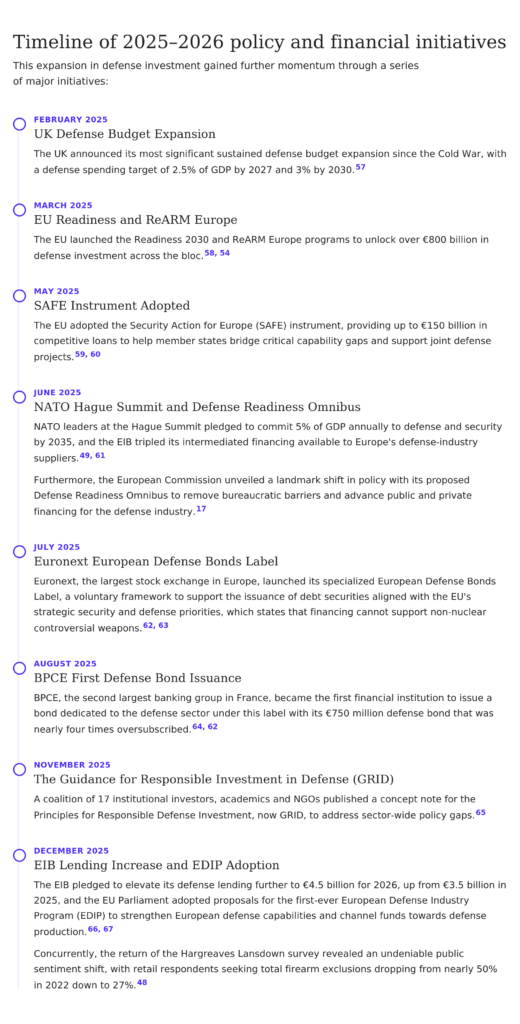
The year 2025 solidified Europe’s entry into a definitive era of rearmament, driven by landmark financial commitments to defense spending, both in support of Ukraine, and to ensure long-term security.54 Global defense spending reached $2.887 trillion with a 2.9% YoY increase, down from 9.4% the previous year due to the United States’ lack of newly approved financial assistance for Ukraine. Spending outside of the U.S., however, surged by 9.2%, driven by a 14% spending increase in Europe, as European NATO allies expanded budgets at the fastest rate since 1953.5 This represents the largest coordinated rearmament effort since the mid-20th century.55 Although U.S. defence spending decreased in 2025, Congress-approved defence spending for 2026 has risen to over $1 trillion and could escalate to $1.5 trillion in 2027 if the latest budget proposal is approved.5
The EU’s own direct defense budget showcases how far and fast this shift has gone, with the European Defence Fund (EDF) seeing a drastic increase from a €1.5 million pilot program in 2015, to a €7.3 billion budget for the 2021–2027 cycle.55 In tandem, the EIB significantly increased its commitments to security and defense, quadrupling the prior year’s expenditures to reach €4 billion in 2025.56
Source: Octus
In parallel with these initiatives, the investment community has begun to develop its own guidance to address the policy gap in defense investment. The investor initiative launched in November, subsequently renamed the Guidance for Responsible Investment in Defense-related companies (GRID) at the start of 2026, is working to provide a framework to help investors approach the complexities of defence-related companies.65 However, questions surrounding dual-use technologies, supply chain accountability, and the growing role of AI and autonomous systems all remain open, and highlight the need for a more granular framework in the aerospace and defense industry. Moreover, even if conventional defense is deemed neutral by regulations, tracking supply chain accountability, weapon end-use, and the destination of military hardware remains operationally difficult, posing severe reputational risks if components are linked to human rights violations.
Regulation has been reclarified, capital is moving and classifications are still evolving. Defense is no longer an automatic exclusion, but it is not a simple inclusion either. Because exposure runs across supply chains and dual-use categories that sector codes miss, and the line between acceptable and excluded now sits inside individual mandates rather than across the market as a whole. This requires activity-level screening rather than sector-level. That is what Octus Activity-Based Screening is built to do.
Sources
- PwC Strategy& | The Evolving Role of ESG in the Defense Industry
- GAA – Global Advisory Alliance | From Exclusion to Engagement: A Stewardship Lens on Europe’s Evolving Defence Investments
- McKinsey | Cutting Europe’s €800 Billion Gordian Knot: Five Catalysts to Transform Defence
- UK Parliament | The impact of environmental, social and governance requirements on the defence industry
- Stockholm International Peace Research Institute | Global military spending rise continues as European and Asian expenditures surge
- Fidelity | Defence and ESG: Navigating a Strategic Shift in a Fragmented World
- World Economic Forum | Global Risk Report 2026
- United Nations | The Treaty on the Non-Proliferation of Nuclear Weapons (NPT)
- Octus Internal SFDR Data | 2025 SFDR PAI Reporting: Defence Sector Exposure
- Reuters | EU Commission proposes reducing red tape for defence industry (June 2025)
- JDSUPRA | Opportunities Emerge in EU Defence Following Rapid Realignment of Post-War Architecture
- FCA | Our Position on Sustainability Regulations and UK Defence
- Council of the European Commission | Commission Note on the Application of the Sustainable Finance Framework and the Corporate Sustainability Due Diligence Directive to the Defence Sector (C/2025/3800 Final)
- Official Journal of the European Union | Commission Notice on the Application of the Sustainable Finance Framework and the Corporate Sustainability Due Diligence Directive to the Defence Sector (C/2025/4950)
- ESMA | ESMA_QA_2372 Questions and Answers
- European Commission | Commission Notice on the Application of the Sustainable Finance framework and the Corporate Sustainability Due Diligence Directive to the Defence sector (C/2025/3800)
- European Commission | Defence Readiness Omnibus
- Official Journal of the European Union | Commission Delegated Regulation (EU) 2025/1775 of 28 August 2025 Amending Delegated Regulation (EU) 2020/1818 as Regards the Definition of Prohibited Weapons
- Hogan Lovells | ESG and Defence in the UK and EU – Navigating the Politics and Legal Requirements to Include Defence Projects in Sustainable Investment Funds
- International Capital Market Association | Guidance Handbook (June 2025)
- Octus Intel
- Octus Intel
- Octus Intel
- Octus Intel
- Octus Intel
- Octus Intel
- Octus Intel
- Octus Intel
- Danske Bank | Danske Bank Expands its Investment Universe for Defence Shares (April 2025)
- The Banker | Sweden’s Largest Lender Shifts Policy on Nuclear Weapons (June 2025)
- IPE | German Associations Relax Exclusion Criteria for Investments in Defence Sector
- IPE | Germany’s Sustainable Funds Shift Gears to Embrace Defence Stocks
- Norges Bank Investment Management | Observation and Exclusion of Companies
- Government.no | The Council on Ethics – Responsible Investment
- CNBC | Norway Urged to Scrap Ban on $1.8 Trillion Wealth Fund Investing in Weapons Makers
- Chief Investment Officer | Norway Pension Giant’s ‘Ethical’ Investment Policy Placed on Hold by Parliament
- Government.no | The Government Follows Up on the Parliament’s Decision Regarding the Ethical Framework for the Pension Fund
- CNBC | California Treasurer Presses CalSTRS Fund to Divest More of its Gun-related Holdings
- New York State Comptroller | NY Common Retirement Fund Announces New Measures to Protect State Pension Fund From Climate Risk and Invest in Climate Solutions
- BusinessWire | BlackRock Introduces Actively-Managed Defense ETF Focused on Global Security and Resilience
- BlackRock | IDEF – iShares Defense Industrials Active ETF
- Vanguard | Vanguard ESG U.S. Stock ETF (ESGV)
- ESG Dive | Vanguard Supports no Environmental, Social Proposals for Second Straight Year
- Plansponsor | Vanguard Settles With States for $29.5M in Coal Stock Manipulation Complaint
- McDermott Will & Schulte | CLO transactions: Spring 2026 Market Trends and Regulatory Developments
- Harvard Law School Forum on Corporate Governance | Defense of Europe as a Responsible Investment
- RUSI (Royal United Services Institute) | Are ESG Standards the Scapegoat for Stalling Defence Growth?
- Hargreaves Lansdown | Why are HL Investors Changing their Minds on Defence Stocks?
- NATO | Deterrence and Defence
- EIB (European Investment Bank) | EIB Approves Strategic European Security Initiative, Confirms Ukraine Disbursement and Backs €543 Million Business and Clean Energy Investment
- Reuters | EU Executive Urges EIB to Start Funding Defence Projects
- EU News | EIB shifts Towards Defense: 1 Billion in Funding in 2024, Aiming to Double in 2025
- Stockholm International Peace Research Institute | Trends in World Military Expenditure
- European Parliament | ReArm Europe Plan/Readiness 2030
- European Union Institute for Security Studies | Funding Weapons Together (or not): How to Pay for European Defence
- Euro News | EIB Spending on Security and Defence Quadrupled to €4bn in 2025
- Ministry of Defence | The Strategic Defence Review 2025 – Making Britain Safer: Secure at Home, Strong Abroad
- European Commission | Commission unveils the White Paper for European Defence and the ReArm Europe Plan/Readiness 2030
- European Defence Agency | Defence Data 2024-2025
- European Commission | Security Action for Europe (SAFE)
- EIB (European Investment Bank) | EIB Triples Financing for Banks to Provide Liquidity to SMEs in the Supply Chain of Europe’s Defence Industry, Signs First Deal with Deutsche Bank
- CMS | European Defence Bonds: a New Capital Market Instrument for Europe’s Defence
- Euronext | European Defence Bond Label
- Groupe BPCE | BPCE, the First Financial Institution in Europe to Issue a Bond Dedicated to the Defence Sector
- EIRIS Conflict Risk Network | Principles for Responsible Defence Investment Concept Note
- Reuters | EIB to Boost Lending for EU Defence Projects in 2026
- European Parliament News | Parliament Greenlights First-Ever European Defence Industry Programme
This publication has been prepared by Octus Intelligence, Inc. or one of its affiliates (collectively, "Octus") and is being provided to the recipient in connection with a subscription to one or more Octus products. Recipient’s use of the Octus platform is subject to Octus Terms of Use or the user agreement pursuant to which the recipient has access to the platform (the “Applicable Terms”). The recipient of this publication may not redistribute or republish any portion of the information contained herein other than with Octus express written consent or in accordance with the Applicable Terms. The information in this publication is for general informational purposes only and should not be construed as legal, investment, accounting or other professional advice on any subject matter or as a substitute for such advice. The recipient of this publication must comply with all applicable laws, including laws regarding the purchase and sale of securities. Octus obtains information from a wide variety of sources, which it believes to be reliable, but Octus does not make any representation, warranty, or certification as to the materiality or public availability of the information in this publication or that such information is accurate, complete, comprehensive or fit for a particular purpose. Recipients must make their own decisions about investment strategies or securities mentioned in this publication. Octus and its officers, directors, partners and employees expressly disclaim all liability relating to or arising from actions taken or not taken based on any or all of the information contained in this publication. © 2026 Octus. All rights reserved. Octus(TM) and the Octus logo are trademarks of Octus Intelligence, Inc.